Facebook took action on 1.4 billion pieces of spam content in Q3 2022, according to Meta's transparency reporting. That's platform-wide enforcement, not an advertising benchmark, but it reframes Facebook ad comment moderation: you need a standing policy, not someone deleting whatever looks uncomfortable.
The harder job is protecting the customer conversation. A scam link deserves intervention. A delivery complaint, skeptical question or blunt price objection deserves a different response. Every hide or deletion is a trust decision, even when only the commenter notices what happened.
Which Action to Take on Each Ad Comment
Meta combines automated detection with human review across its enforcement system. Your advertising team needs its own practical triage policy because a comment can reach prospective buyers before anyone opens the moderation queue.
Start with intent and risk, not sentiment. Negative language doesn't automatically mean abuse, and a friendly-looking reply can still send customers to a phishing page.
Default action for each ad comment type
| Comment type | Example | Default action | Escalate to a person when |
|---|---|---|---|
| Spam or bot promotion | Repeated DM-us-for-guaranteed-returns replies copied under several ads | Hide | No routine escalation unless the sender names a real customer |
| Scam or phishing link | Lookalike login page posted under the ad | Hide and report | Customers have already replied or clicked |
| Abusive language | Slur aimed at a staff member | Hide | The comment names a person or contains a threat |
| Legitimate complaint | Delivery took three weeks | Leave visible and reply | A refund or account issue is involved |
| Product question | Does this fit a size M? | Reply with a link or image | No specialist escalation for a standard sizing question; answer publicly |
| Sarcasm or local slang | Great, another price rise | Human review before any action | Always; don't auto-hide |
| Misinformation about the offer | It's free forever, when it isn't | Reply with a correction | The claim touches pricing, health or legal terms |
| Buying signal | What's the price in Canada? | Reply and route to sales | Large orders or enterprise quotes |
These defaults aren't permission to ignore context. A complaint containing a suspicious link might be a customer documenting fraud. A repeated product question might mean your landing page is missing essential information, not that the customer is spamming.
Check the thread before acting
Open the parent comment and surrounding replies before making a borderline decision. Check the destination of a suspicious link without entering credentials, compare repeated text across ads, and read the offer the commenter saw.
Preserve evidence before removing threats or suspected fraud. Save the comment identifier, relevant wording and action taken in an access-controlled log. Don't copy customers' personal details into a general campaign spreadsheet.
Practical rule: Prefer hide-and-review over deletion whenever platform controls allow it. Never build an automatic hiding rule around wording that could be a genuine customer question.
Deletion should be deliberate, not the default cleanup button. A moderator should be able to explain the action in terms of fraud, abuse or another documented rule, rather than merely disliking the comment.
Who Owns the Moderation Queue and How Fast to Reply
Give the queue a named owner and a named backup. Shared access isn't shared accountability: if everyone assumes someone else is checking hidden comments, mistakes can sit untouched.
The owner should know which ads are delivering, which offers are current and who can resolve customer problems. For agencies, specify whether the agency or client handles the public reply, not just who receives the notification.
Set service windows your team can meet
Use these as operating commitments, not claimed Facebook requirements:
- Spam and scam links: Configure immediate intervention where supported, with monitoring for missed cases.
- Product questions and buying signals: Reply within the same working day, using approved product and offer information.
- Complaints: Acknowledge publicly within the same working day, even if the resolution needs more investigation.
- Named staff members or threats: Send to a senior reviewer promptly. Credible safety concerns shouldn't wait for a routine queue check.
Document business hours and the response customers receive outside them. Don't promise an immediate resolution when support is offline.
Make escalation executable
Write the escalation path as a compact reference: who approves refunds, who fixes account access, who signs off pricing or health-related corrections, and who handles enterprise quotes. Include contact methods and an alternate approver.
The same ownership discipline used by effective marketing teams applies here: assign the next action to a person, not a department.
Keep a shared decision log with the action, reason, reviewer and rule changes. Schedule a fixed weekly hide-log review so the backup can challenge decisions and restore comments where appropriate.
Before holidays or campaign launches, hand over unresolved threads, sensitive offers and account permissions explicitly. No ad should launch without an accountable comment owner, including ads scheduled while the usual team is away.
Set Up Native Moderation Rules in Five Days
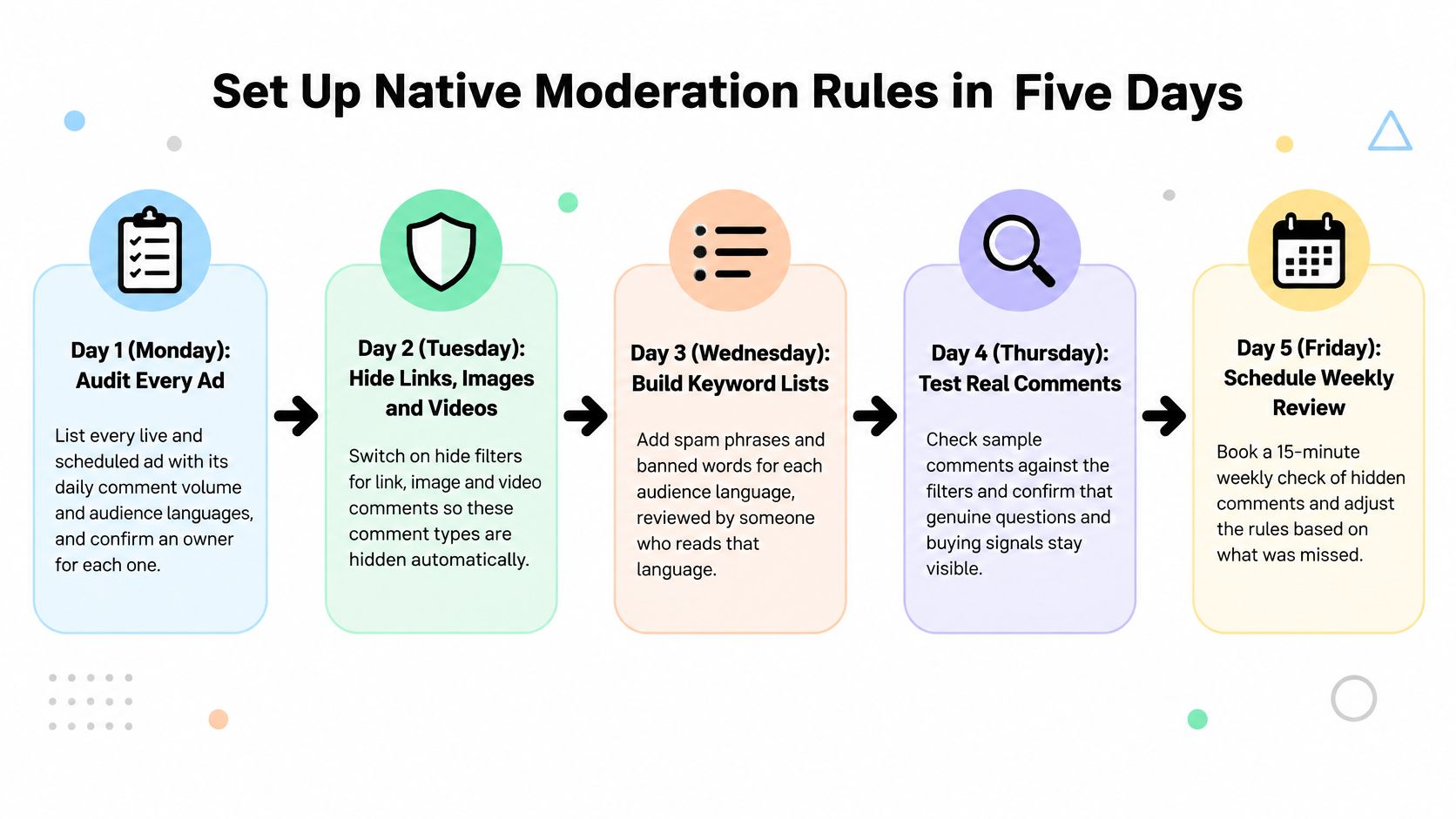
Treat this as a setup schedule, not a promise that filters will be safe without supervision. Meta's Moderation Assist guidance describes criteria for automatically hiding comments containing links, images or videos, with rules applying only to comments posted after those criteria are created.
That timing matters. Turning on a filter does not clear older threads, and a broad media filter can catch useful customer evidence alongside spam. Every hidden comment is also a trust decision: the commenter can notice it, other prospects can read the gap, and a removed pricing question can look like avoidance even when the intent was cleanup.
Monday and Tuesday establish coverage
Monday: Inventory live and scheduled ads in Ads Manager. Record each ad's identifier, destination post, observed daily comment volume, audience languages and queue owner. Include reused posts so you do not mistake several ads sharing one discussion for separate queues.
Tuesday: Open the Page's professional dashboard and locate Moderation Assist. Labels and availability can differ by account, so confirm you are managing the correct Page before adding criteria.
Configure available link, image and video rules before delivery starts, but inspect what each rule would catch. A legitimate question linking to your sizing guide is a useful counterexample to a blanket link filter. If the team cannot review hidden media comments promptly, leave a broad filter off rather than enabling it because the switch exists.
Wednesday through Friday validate the decisions
Wednesday: Review comments posted before activation manually. Build language-specific spam phrases with someone who reads the language, and record the comment ID, ad ID, timestamp, language, action, rule version and reviewer decision for each sampled item.
Thursday: Test representative comments: a lookalike login link, an image-only promotion, a genuine complaint with a photo and a product question containing a URL. Compare reviewer labels with the rules' decisions and look for the two failure modes that matter: a real buying signal hidden, or a harmful pattern still visible.
Friday: Inspect the hide log and restore genuine sales questions or complaints. Assign replies, revise noisy criteria and reserve a recurring review slot so the setup does not decay after launch week.
Native moderation settings, scope and timing
| Setting | Applies to | Timing rule | What to check |
|---|---|---|---|
| Link filter | Comments on ads, Page posts and professional profile posts | Only comments made after the rule exists | Test a sample link, then review earlier comments manually |
| Image filter | Same scope as link filter | Only comments made after the rule exists | Confirm image-only spam is hidden |
| Video filter | Same scope as link filter | Only comments made after the rule exists | Check video-only comments among earlier comments you review manually |
| Ad comment API, retrieve, create, delete | Comments tied to ad media and the required ad identifiers | Requires permissions and identifiers before actions | Log actions with ad ID and rule version |
| Organic thread comments | Separate access paths with different limits | Do not assume an ad-ID workflow covers them | Confirm coverage or document the gap |
If you use the API, build rate-limit-aware queues and idempotent actions. Store processing state against the comment and intended action so a retry does not publish the same response again.
Make the launch check concrete: a test comment appears in the expected queue, the appropriate reviewer can access it, and the team can identify which rule caused any automated action. Keep criticism visible when it is answerable, keep sales questions visible when they are genuine, and reserve hiding for spam, safety risks and clear policy violations.
How Exerta Can Help
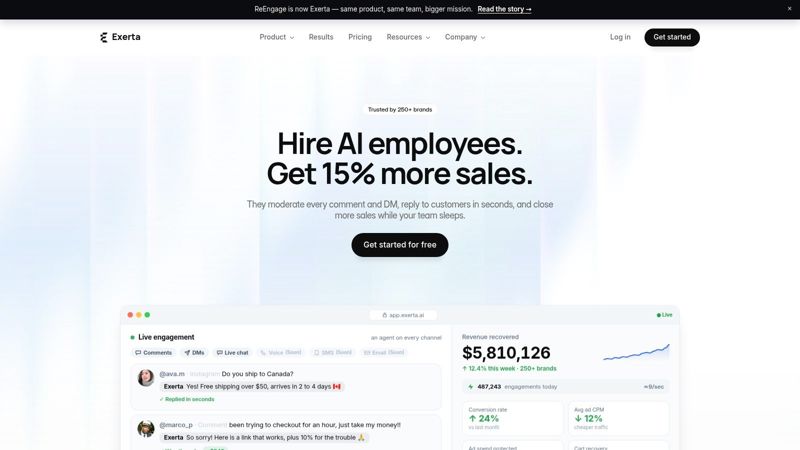
A tool evaluation should start with the distinction between automatic action, human review and comments left visible. Exerta is relevant when your team needs those decisions connected to replies, private messages and sales follow-up rather than handled in isolated inboxes.
Exerta deploys AI agents for customer engagement across Facebook, Instagram, TikTok and website chat. Its capabilities include brand-trained replies, moderation rules, buyer-intent detection, checkout links, configurable escalation and action logs. Its guide to Facebook ad comment moderation offers context for evaluating that combined engagement workflow.
Where it can replace manual handoffs
For an ecommerce team, the useful sequence is practical: identify a stock question, answer from approved information, recognize purchase intent and route the conversation toward checkout. Workflow branching and logs let the operator inspect why the agent replied, hid a comment or escalated it.
Agencies can evaluate it for consistent handling across client accounts. Lead-generation and telehealth teams should put more weight on approval controls and escalation than on conversational fluency, especially where a reply could imply eligibility or make an unsupported claim.
What to test before committing
- Criticism handling: Feed the system a blunt but legitimate complaint. Check whether it stays visible and receives a useful response.
- Offer accuracy: Test expired discounts, market-specific prices and unavailable products.
- Escalation control: Confirm the agent stops when a question needs a qualified person.
- Auditability: Inspect the record of the trigger, response and subsequent outcome.
Exerta is a stronger fit when engagement volume makes manual routing difficult and you need cross-channel oversight. It's harder to justify if a manageable native queue already meets your needs.
Don't enable a broad negativity rule just because the platform supports it. Judge the deployment by accurate answers and protected customer conversations, not the number of comments hidden.
Automation, Human Review and Protecting Real Leads
A comment section is a shop window, not a warehouse floor. Clearing everything uncomfortable may make it look tidier while removing information shoppers need to decide whether they trust you.
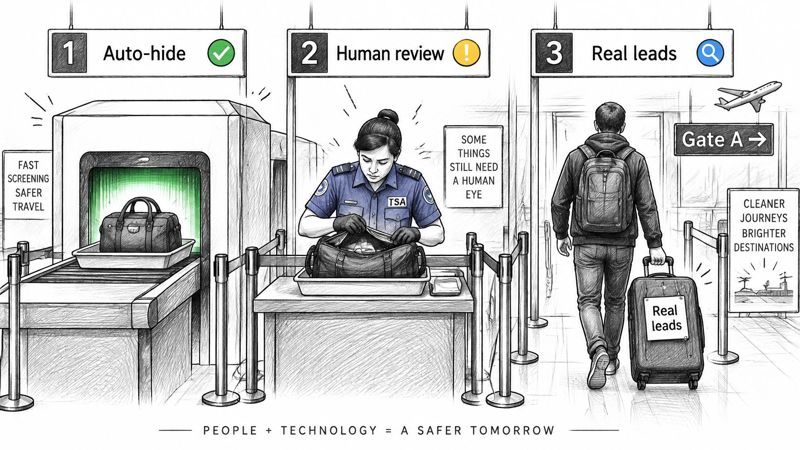
For operations, airport screening is a better analogy: the scanner handles recognizable patterns, while an officer examines what the scanner can't confidently interpret. The goal isn't maximum intervention. It's appropriate intervention with a review path.
Give automation a narrow job
A large-scale academic study of Facebook moderation analyzed 412 million comments posted between January and August 2022 and found that automated moderation increased subsequent adherence to Community Guidelines. That finding supports enforcement as more than cosmetic cleanup, but it doesn't establish a sales lift for moderated ads.
Meta's enforcement overview describes a combination of automated technology and human review. For advertisers, the useful translation is to separate clear matches from uncertain meaning:
- Automatic hiding: Known scam destinations, copied promotional patterns and previously confirmed abusive phrases.
- Human review: Ambiguous accusations, sensitive claims, sarcasm and wording that changes meaning with context.
- Visible discussion: Ordinary questions, fair objections and comments needing no intervention.
Keep labels separate from actions. Spam, harassment, policy risk, legitimate objection and sales opportunity describe different problems; treating them all as negative sentiment makes useful review impossible.
Measure errors in both directions
A weekly sample should include hidden comments and comments the system left visible. Inspecting only hidden comments tells you whether you acted correctly, but not what you missed.
Calculate:
- Precision: Correctly actioned violating comments divided by all comments actioned in the reviewed sample.
- Recall: Correctly detected violating comments divided by all violating comments identified by reviewers in the sample.
- False-positive rate: Permissible comments incorrectly actioned divided by all permissible comments reviewed.
Report those measures by language, market and campaign where the sample supports a meaningful comparison. Keep the sampling method consistent, and inspect sensitive cases separately rather than allowing them to disappear inside an aggregate.
When comparing social media automation tools, ask whether you can export the original comment, decision, rule and reviewer outcome. A dashboard showing only actions completed won't support this audit.
Restore the lead, then repair the rule
Say a customer asks whether a product is affected by a recall. A filter catches the word recall and hides the question as reputational risk.
The reviewer should restore the comment where supported, check the approved product-safety information, and provide an appropriate public answer. Then remove or narrow the rule and inspect other comments it caught. Otherwise, the team corrects an isolated mistake while leaving the cause active.
A clean hide log isn't proof of a healthy conversation. Check what the system removed and what it failed to recognize.
The operational trade-off is straightforward: broader detection can catch more harmful material but also interfere with legitimate speech. Reserve irreversible actions for decisions the team can defend.
Responding to Negative Feedback and Criticism
A shopper calling an offer sick might be praising it; another using the same word might be describing a serious product concern. The word alone doesn't tell you whether to celebrate, investigate or escalate.
Deleting criticism is like wiping a complaint off a shop window without fixing the goods behind it. The person who posted it still knows what happened, and an unexplained disappearance can become a separate complaint.
Respond to the claim, not the tone
A 2025 study of user attitudes toward moderation found that participants generally accepted deletion more readily for insults, preferred interactive responses such as counterspeech for misinformation, and viewed unexplained AI deletion less favorably than human moderation with an explanation. The practical distinction is between stopping abuse and answering a contestable claim.
Use response patterns that resolve the issue rather than merely sound polite:
- Product complaint: Acknowledge the specific problem and state the next action. If the fix isn't known, explain what the team will check.
- Misleading offer claim: Give the correct terms, with an approved offer page or explanatory image. Don't accuse a confused customer of lying.
- Order details or refunds: Acknowledge publicly, then move account information into an appropriate private channel.
- Tough but fair criticism: Leave it visible and answer the substance without arguing about the customer's attitude.
A pricing objection doesn't require a defensive essay. Explain what's included, identify any relevant alternative and let the customer decide whether the offer suits them.
Make the response useful to onlookers
For example, a shopper challenges a shipping promise. Reply with the applicable destination, dispatch conditions and delivery guidance rather than pasting a generic apology. If using an image, repeat the essential terms in text so the answer doesn't depend on opening the image.
Good social media engagement includes answering difficult questions, not just encouraging positive reactions. A visible complaint followed by a specific, proportionate response can give other shoppers something meaningful to evaluate.
Would a neutral customer consider the decision fair if they could see the original comment and your reason for acting?
Use that test before hiding a borderline comment. A cleaner thread isn't automatically a more credible one, and a calm public answer is often the more defensible decision.
Keeping Multilingual and Cross-Border Campaigns Fair
Suppose a slang term is a routine price complaint in one market but a personal insult in another. An English-led keyword list won't reliably distinguish the meanings, especially when customers mix languages within a sentence.
An analysis of Meta's AI moderation in the Global South identifies challenges associated with Western-centric assumptions, linguistic variety and local context. For a campaign operator, the implication is practical: translating a blocked-word list isn't the same as validating a moderation policy.
Audit decisions by market
Build multilingual test sets from actual campaign language, with personal details removed. Include dialect, code-switching, sarcasm, ordinary price objections and references a reviewer outside the market might misunderstand.
Ask operational questions rather than relying on an overall accuracy score:
- Unequal hiding: Are permissible comments from a particular language group being restricted more often?
- Misclassification: Are local buying expressions being labeled as spam or abuse?
- Escalation burden: Do certain markets wait longer because no reviewer understands the context?
- Missed harm: Are locally recognizable scams passing through rules designed elsewhere?
Report hide, delete, reply and escalate separately. A market with many escalations may need better reviewer coverage, while a market with excessive hiding may need narrower rules. Those are different fixes.
Localize the explanation as well as the offer
Have a reviewer who understands the market assess culturally sensitive cases before changing the rule. Record the meaning and context, not just an English translation, so the next reviewer can apply the decision correctly.
For localized campaigns, an explanatory image can present destination-specific shipping, eligibility conditions or translated offer terms instead of suppressing a confused question. Keep the underlying information approved and current, and avoid placing personal customer information into public reply assets.
Use automation for recognizable risk patterns and people for context-heavy interpretation. Fair moderation means customers can question an offer in their own language without being mistaken for a threat.
Before your next campaign launches, assign the queue owner, test the rules against genuine customer questions and review what gets hidden. If repeated questions need clearer visual answers, use OKZest to create personalized images with approved shipping details, offer explanations or localized FAQs. Start with a recurring question, build a reusable template and give your moderators a useful answer they can share instead of reaching for Hide.