If you're an email marketer, you're probably already using merge tags like {{first_name}} to make your copy feel more personal. Now, what if you could do the exact same thing with your images?
That’s the simple idea behind dynamic visuals. They are essentially merge tags for pictures, turning one single image template into a completely unique visual for every person who sees it. It’s how you cut through the noise and create a true one-to-one connection with your audience.
What Are Dynamic Visuals and Why Do They Matter
Imagine sending an email campaign where, instead of a generic banner, each subscriber gets an image that says, "Welcome, Sarah!" or "Here's your ticket, David!"
That's a dynamic visual in action. These aren't your standard, one-size-fits-all JPEGs. They're intelligent, data-driven images that pull information directly from your CRM, email list, or other data sources. This creates a relevant and personal experience that people actually notice, which is a game-changer when most of us have learned to ignore generic ads.
Moving Beyond Static Content
The difference between a static image and a dynamic one is night and day. A static visual is made once and shown to everyone, no matter who they are. A dynamic visual, on the other hand, adapts. This turns a simple graphic into a powerful communication tool that can seriously boost engagement and fight off ad fatigue.
By making content specific to the individual, you're no longer just broadcasting a message; you're starting a conversation. This shift from monologue to dialogue is what makes dynamic visuals for marketing so effective.
This whole strategy really boils down to three key parts: personalization, data, and engagement. When you get them working together, the results are powerful.
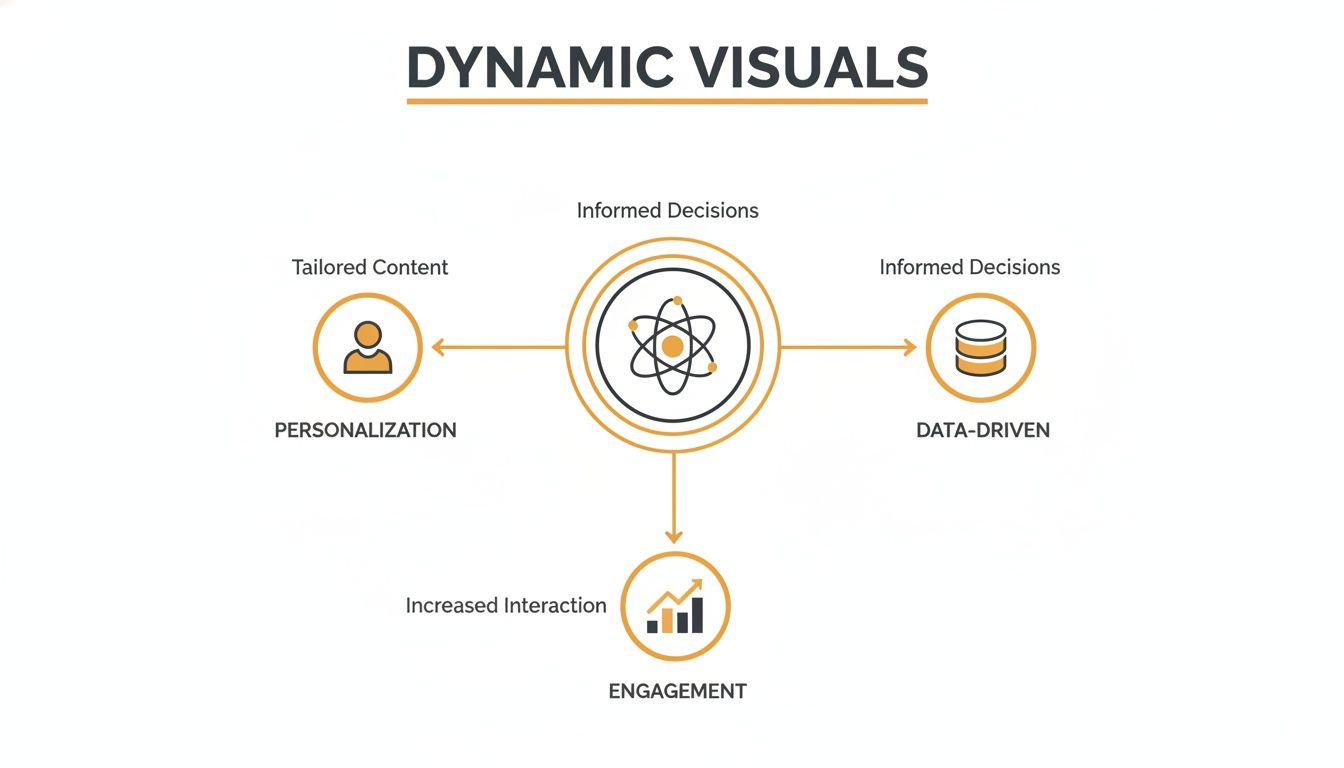
As the diagram shows, you're combining user data with a flexible visual template to create a highly personalized experience for your audience. That's the engine that drives this whole approach. If you want to go a bit deeper on this, check out our guide on what is dynamic content.
Static vs Dynamic Visuals A Quick Comparison
To really see the difference, it helps to put the two side-by-side. The table below breaks down how traditional static visuals stack up against modern dynamic ones.
| Feature | Static Visuals (e.g., JPEG, PNG) | Dynamic Visuals (e.g., Personalized Images) |
|---|---|---|
| Personalization | One message for all viewers | Unique message for each viewer |
| Relevance | Low to moderate; generic | High; based on user data |
| Engagement | Lower click-through and interaction rates | Significantly higher engagement and CTR |
| Scalability | Manual creation for each variation | Automated creation of infinite variations |
| Data Integration | None; image is fixed | Real-time data from APIs, CRMs, etc. |
| User Experience | Impersonal and often ignored | Memorable and conversational |
It’s pretty clear how dynamic visuals give you an edge. They consistently deliver a more tailored and effective experience that helps you hit your marketing goals, from engagement right through to conversion.
The Visual Content Market is Booming—Here's Why
The surge in dynamic visuals for marketing isn't just a passing trend. It's a direct answer to a huge shift in how businesses connect with people. We've gone way past just making things look pretty. Today, visuals are a core engine for business growth, and the numbers behind this change are pretty mind-blowing.
Last year alone, the global visual content market swelled to $5.2 billion. Forecasts predict it will explode to an incredible $19.17 billion by 2032, growing at a rate of 15.6% each year. This growth is tied directly to the rise of AI in creating media, a topic you can dive deeper into with these visual content statistics.
The AI-Powered Creative Shift
So, why is this market exploding? It's because the tools to create amazing, personalized visuals are finally within reach for everyone. Artificial intelligence is the main reason for this. With nearly 75% of marketers already using AI to create images and videos, the power to generate unique visuals for every single customer is no longer some far-off idea—it's here, right now.
This means that what used to be possible only for giant companies with massive design teams is now open to all. Whether you're a solo entrepreneur or a marketing agency, the old barriers have come tumbling down.
This isn't just about a new piece of tech; it's about accessibility. The market now lets any business compete on a visual level, using personalization to build real connections that just weren't possible before.
Why This Market Shift Matters to You
Okay, so a multi-billion-dollar market sounds impressive, but what does it actually mean for your business? It’s a clear signal that it's time to adapt. When most of your competitors are finding smarter, faster ways to create content that grabs attention, sticking with the old one-size-fits-all images puts you at a real disadvantage.
Investing in dynamic visuals is no longer a "nice-to-have"—it's a strategic move to stay competitive. This is where accessible platforms like OKZest make all the difference, bridging the gap between complicated technology and your day-to-day marketing needs.
These tools let you tap into this powerful market by helping you:
- Automate Repetitive Design Work: Forget about manually creating dozens of slightly different versions of the same image.
- Integrate with Your Current Tools: Connect smoothly with your email marketing platform or CRM.
- Scale Your Personalization: Deliver a unique, one-to-one experience to thousands of customers automatically.
Getting on board with dynamic visuals for marketing means you’re not just keeping up. You’re setting your brand up to win in a world where personalized, engaging content is the new standard.
How Dynamic Visuals Amplify Audience Engagement
At their core, dynamic visuals work because they tap into a basic human desire: to be seen and understood. Think about it. A generic image is like shouting into a crowd, hoping someone listens. A personalized visual, on the other hand, is like a one-on-one conversation. That simple change is why the engagement metrics go through the roof.
In today's marketing, motion and personalization are everything. It’s why social videos can rack up a stunning 1,200% more shares than text and static image posts combined. This isn't just about chasing likes; it's about making content so relevant that people genuinely want to share it. You can dig deeper into this trend in the 2026 Marketing Trends Report.
Turning Clicks into Connections
High engagement isn't just a feel-good metric—it's how you build real customer relationships. When your content speaks to someone personally, they're far more likely to interact with it, remember your brand, and eventually, become a customer. This is the real power of using dynamic visuals for marketing.
The goal is to move beyond passive consumption. A dynamic visual prompts an action—a share, a click, or even just a moment of genuine surprise—that deepens the viewer's connection to your brand.
Take an event organizer, for example. Instead of emailing a boring PDF ticket, imagine sending a personalized digital ticket with an animated background and the attendee's name styled beautifully on it. That small touch turns a functional item into a memorable, shareable experience that builds excitement long before the doors even open.
The Real Business Impact of Engagement
So, how does all this engagement translate into actual business results? Higher engagement creates a positive feedback loop that directly impacts your bottom line.
- Increased Dwell Time: Personalized, moving content grabs attention and holds it, keeping people on your page or post longer. This tells algorithms your content is valuable, which in turn boosts its organic reach.
- Higher Click-Through Rates (CTR): When a visual speaks to a user’s context—like an image showing a product they just looked at—they are much more likely to click through and explore further.
- Better Brand Recall: A unique, personalized experience is far more memorable than another generic ad. This helps your brand stay top-of-mind when a customer is finally ready to buy.
Each of these metrics—longer dwell times, higher CTRs, and stronger brand recall—are stepping stones toward more conversions and revenue. By focusing on engagement through personalized visuals, you’re not just making your marketing look better; you’re making it work harder for your business.
Alright, let's get into the good stuff. Theory is one thing, but seeing how dynamic visuals actually work in marketing is what really gets the ideas flowing. Let's look at a few powerful ways you can use personalized images to turn generic touchpoints into moments that really connect.
Transform Your Email Welcome Series
Your welcome email is one of your most opened communications—it's your best chance to make a great first impression. Instead of a generic banner, imagine a new subscriber seeing an image that greets them by their first name.
For anyone using an email platform like Klaviyo, this is incredibly easy to set up. You can design a beautiful welcome image in a tool like OKZest and use a merge tag—just like you do for text—to pull the recipient's name right into the visual.
A generic welcome email gets lost in a crowded inbox. It's forgettable. But a dynamic image with a simple, "Welcome to the club, Jessica!" makes your new subscriber feel seen. That small touch builds a stronger brand connection from day one and sets your emails apart.
Automate Event Certificates and Tickets
If you've ever organized an event, you know the pain of manually creating and sending attendance certificates or personalized tickets. It’s tedious, takes forever, and is ripe for human error. Dynamic visuals are a game-changer here.
You can connect your event registration list to a dynamic image template and automatically generate a unique certificate for every single attendee. Each one can include their full name, the event title, and the date. Then, just automate the email delivery. You just saved yourself hours of mind-numbing work.
This same idea works perfectly for creating personalized digital tickets before an event, building excitement with a custom touch that gets people ready to attend.
Hyper-Personalize Your Sales Outreach
In sales, cutting through the noise is everything. A generic outreach email is just asking to be ignored, but one that’s clearly made for the recipient? That gets a click.
Imagine your sales rep sends an email where the image includes the prospect’s name, their company logo, and a relevant question. Something like, "Michael, ready to boost [Company Name]'s Q3 sales?"
This proves you’ve done your homework and aren't just blasting out another mass email. By connecting your CRM data to an image platform like OKZest, your team can create these custom visuals at scale. It turns a cold outreach into a warm introduction, which is exactly what you need to book more meetings.
Getting Started: No-Code or API?
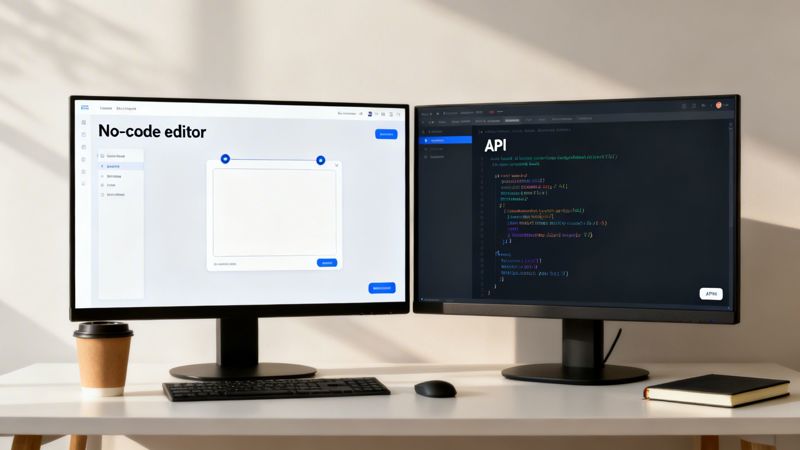
It’s one thing to see the potential of dynamic visuals, but it’s another thing to actually put them to work. The great news is you don’t need a team of developers on standby. There are two straightforward paths for bringing personalized images into your campaigns: the no-code route and the API route.
Think of it like building a website. You can use a visual, drag-and-drop builder to get a great-looking site live in no time. Or, you can code it from the ground up for total control. Both options get the job done—the right choice just depends on your team’s skills and how big you want to go.
The No-Code Path: For Quick Wins and Easy Setup
For most marketers, founders, and teams without a dedicated developer, the no-code approach is the perfect place to start. Platforms like OKZest give you an intuitive visual editor where you can design your image templates without writing a single line of code.
If you’ve ever used a design tool, you’ll feel right at home. You can upload your background images, add text, and place different elements. The real magic happens when you mark certain layers as "dynamic," which tells the system to pull in data later—like a customer’s name or company logo.
Once your template is set, the platform generates a simple URL. You can then paste this link directly into your email marketing tool, website builder, or social media scheduler. By adding your tool's merge tags to this URL, you connect it to your audience data, and the platform handles the rest. You can see just how simple it is to get started with no-code image design automation.
This path is ideal for:
- Email Marketers personalizing campaign banners in Klaviyo or Mailchimp.
- Event Organizers who need to automate personalized certificates for attendees.
- Sales Teams creating custom outreach images without asking for a developer's help.
The API Path: For Ultimate Scale and Integration
For developers, agencies, and businesses that need to create personalized visuals on a massive scale, the API (Application Programming Interface) path offers incredible power and flexibility. This approach lets you programmatically generate thousands—or even millions—of unique images on the fly.
An API is like a messenger that lets your software "talk" to the image generation service. Your app sends a request with the data, and the service sends back a brand-new, personalized image.
Instead of building URLs by hand, your developers can write code that sends data directly to a service like OKZest. The API instantly returns a unique image for every single request. This allows for deep integrations with your existing systems, from a custom CRM to a huge e-commerce platform.
The API path is built for tasks like:
- Large-scale personalization, such as a travel site showing customized vacation offers to millions of different users.
- Deep product integration, like an app that generates personalized social sharing cards for its users.
- Fully automated workflows, where images are created in real-time based on a customer's actions or triggers from your database.
By using an API, you can build a true visual marketing engine that works automatically, delivering a one-to-one experience for every customer, no matter how much you grow.
Best Practices for a Winning Dynamic Visuals Strategy
Great technology is only half the battle. To make your dynamic visuals truly connect with your audience, you need a smart strategy guiding your efforts. These best practices will give you the guardrails to make sure your campaigns drive results, not technical headaches.
So, what happens if you want to personalize an image with a first name, but that data is missing for a particular user? Without a plan B, you could end up sending a broken or awkward-looking visual.
This is where fallback data is your safety net. Any good dynamic image platform, including OKZest, lets you set a default value—like "Friend" or "There"—that automatically slots in when the primary data is missing. It's a simple step that keeps every visual looking professional and complete.
Designing for Variable Data
Another key to getting this right is designing your templates to handle variability. A design that looks perfect with the name "Sam" might fall apart when you need to fit "Christopher." You have to anticipate these differences when creating your visual templates.
Keep these core design principles in mind:
- Leave Ample Space: Make sure your text area is wide enough to accommodate longer names or phrases without crowding other design elements.
- Center Your Text: Centered alignment is often much more forgiving with varying text lengths compared to left or right alignment.
- Test with Extremes: Always preview your template with both very short and very long inputs. This helps you spot and fix potential layout issues before you go live.
Planning for these variations is what ensures your dynamic visuals for marketing look polished and professional for every single person who sees them.
Personalization should feel helpful, not creepy. Stick to using first-party data—information customers have willingly shared with you—to create relevant experiences, like a personalized welcome image. It's best to avoid using sensitive or overly personal information that might make people uncomfortable.
This thoughtful approach is gaining serious ground as marketers move beyond just text-based personalization. In fact, 22% of marketers now cite expanding into visual content as their top diversification strategy. And with AI tools powering nearly 75% of media creation workflows, this trend is only accelerating. You can read more about it in HubSpot's latest marketing report.
Ultimately, a winning strategy is a mix of solid fallbacks, flexible design, and respectful data use. To get a better look at the tools that can make all this happen, you might want to check out our comparison of the best dynamic image generation tools.
Frequently Asked Questions
Diving into any new marketing tool can feel a little daunting, and it's natural to have questions. We hear a few common ones all the time when it comes to dynamic visuals, so let's clear them up.
Is This Too Technical For My Small Team?
Not at all. This is probably the biggest myth we see. Modern platforms like OKZest were built specifically for marketers, not developers.
If you're comfortable with a simple drag-and-drop editor or know how to use merge tags in your email tool, you have all the skills you need. You can design your image, connect the dynamic fields, and get a snippet to paste into tools like Mailchimp or Klaviyo in minutes.
What If I Don't Have Personalization Data For Someone?
This is a great question, and it's handled by a simple but powerful feature: fallbacks.
Let's say your image is set up to pull in a first name, but you have a contact without that data. A fallback rule automatically swaps in a default word you've chosen, like 'Friend' or 'You'.
This feature is your safety net. It guarantees every single person receives a complete, professional-looking image, so you never have to worry about broken links or awkward blank spaces.
How Much Does It Cost To Get Started?
The cost is designed to scale with your business. Many services, including our own here at OKZest, have pricing tiers that start with a completely free plan. This makes it easy for anyone to try it out and see the impact for themselves.
As you generate more images, you can move to a plan that fits your volume, whether that's a few thousand or millions per month. It's a budget-friendly approach that lets you start small and grow your investment as you see results.
Ready to create memorable, one-to-one experiences that capture attention? OKZest makes it easy to automate personalized images for your email, web, and social media campaigns. Get started for free on okzest.com.