In a crowded market, generic, one-size-fits-all images no longer capture attention. Your audience expects content that speaks directly to them, reflecting their name, interests, or recent activity. Relying on static visuals means you're missing a critical opportunity for connection, which directly impacts engagement and conversion rates. The core problem is that a single image cannot be relevant to every individual viewer.
This is where dynamic image generation platforms come in. These tools automatically create thousands of unique, personalized image variations from a single template, inserting dynamic data for each user. To counter the diminishing returns of static content, strategies like Dynamic Creative Optimization (DCO) are essential, leveraging AI to deliver highly personalized ad content that resonates with individual users. The result is a more relevant and compelling visual experience across email campaigns, social media, and sales outreach.
Finding the right solution can be time-consuming. This guide cuts through the noise to help you select from the best dynamic image generation tools for your specific needs. We’ve analyzed each platform, detailing its standout features, ideal use cases, and pricing structures.
You'll discover which tools are best for:
- Email marketers needing personalized email banners.
- Agencies managing high-volume social media content.
- Sales teams creating personalized outreach visuals.
- Event organizers generating custom tickets or badges.
Each entry includes screenshots, direct links, and a practical analysis of its pros and cons, allowing you to make an informed decision quickly. We’ll show you not just what these tools do, but how to implement them effectively to stop losing conversions to static content.
1. OKZest
OKZest stands out as a powerful and exceptionally well-rounded platform, making it a top contender among the best dynamic image generation tools for marketers and developers alike. Its core strength lies in its dual-approach architecture, which pairs a user-friendly, no-code visual editor with a robust REST API. This design allows marketing teams to launch personalized image campaigns quickly without developer support, while engineering teams can integrate complex, data-driven image generation directly into their applications.
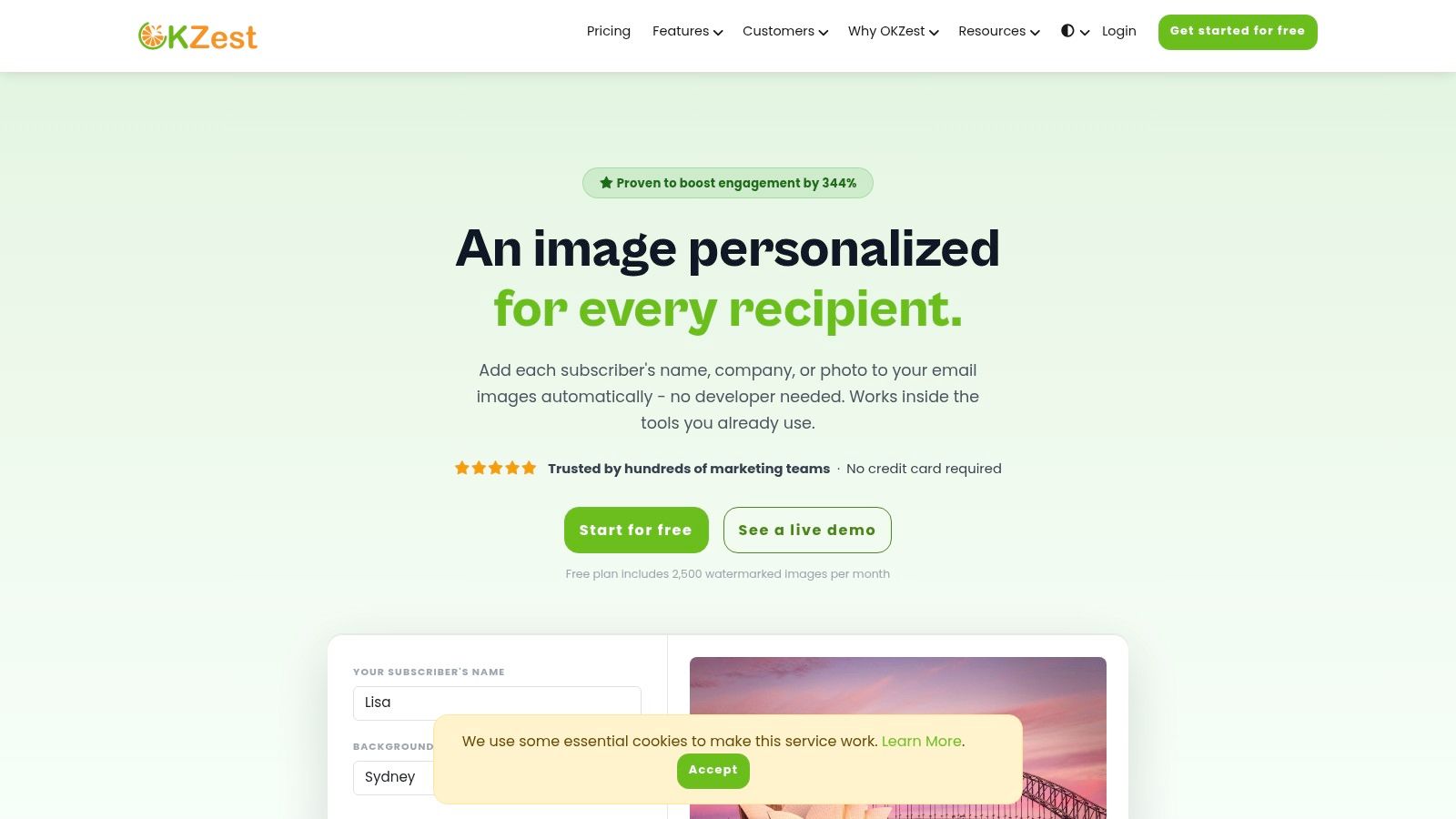
The platform’s real-time personalization capability is a significant advantage. Instead of generating a static batch of images, OKZest creates a single template URL that renders a unique image for each recipient at the moment they open their email or view the webpage. This enables dynamic updates and ensures the data displayed is always current. For a deeper dive into the mechanics, you can explore their guide on how dynamic image generation works.
Key Features & Use Cases
- User-Friendly Editor: A drag-and-drop interface lets you design templates with layers for text, images, and shapes. You can map these layers to merge tags from your ESP (e.g.,
{{first_name}}) or data from an API. - Developer-Grade API: The REST API supports bulk and programmatic generation, ideal for large-scale campaigns, app integrations, or automated workflows.
- Broad Compatibility: OKZest works with nearly any email service provider, including Mailchimp, Klaviyo, and SendGrid, by using a simple image URL. No complex integration is needed.
- Built-in Analytics: Track image impressions and clicks directly within the platform to measure campaign performance without relying solely on your ESP's metrics.
- Team Collaboration: Paid plans feature workspaces and role management, making it suitable for agencies and larger marketing departments that need to collaborate on projects.
Pricing and Access
OKZest offers a generous free trial that includes 2,500 watermarked image generations per month and doesn't require a credit card. This allows teams to test the full functionality before committing. Paid tiers are designed to scale, supporting millions of images per month and adding enterprise features like advanced collaboration and dedicated support.
Pros & Cons
| Pros | Cons |
|---|---|
| Proven engagement lift (advertises a 344% average increase) | Images on the free plan are watermarked and limited to 2,500/month |
| Simple, fast deployment with a single image URL | Paid tier pricing is not publicly listed, requiring a demo or contact for high-volume quotes |
| Flexible for both marketers (no-code) and developers (API) | Effectiveness depends on email clients loading images, a common limitation for all image-based personalization |
| Real-time image updates and built-in engagement analytics | |
| Responsive support via text or scheduled video calls |
Website: OKZest.com
2. Bannerbear
Bannerbear is a mature, developer-friendly platform for programmatic media generation. It operates on a template-based system, allowing users to design master visuals in a drag-and-drop editor and then use an API or no-code tools to create thousands of variations automatically. This makes it a strong contender among the best dynamic image generation tools for agencies and tech-savvy marketing teams running high-volume campaigns.
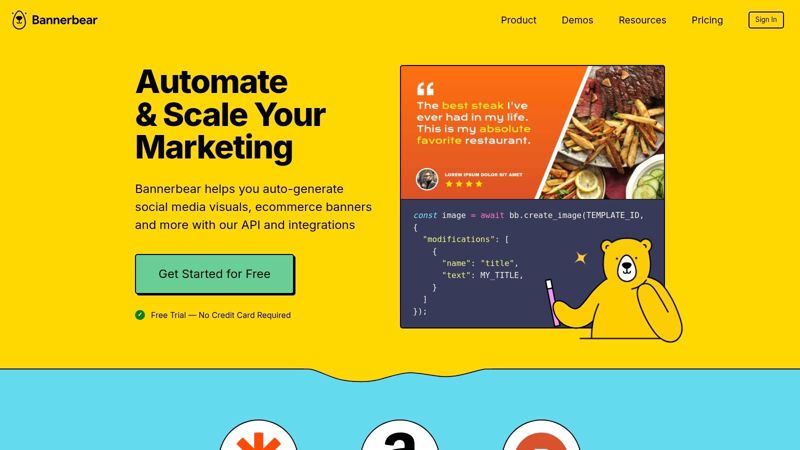
The platform's core strength lies in its robust REST API, which supports both synchronous (real-time) and asynchronous (background processing) rendering. This flexibility is ideal for diverse applications, from generating on-the-fly social media images to batch-creating thousands of product mockups for an e-commerce store. For those less comfortable with code, Bannerbear provides extensive integrations with Zapier, Make, and Airtable.
Key Features and Implementation
- Multi-Format Generation: Beyond images, it can produce dynamic videos and PDFs from the same templates.
- Flexible API: Offers synchronous endpoints for fast, real-time results and asynchronous endpoints for large, non-urgent jobs.
- URL-Based Rendering: Simple URL parameters can be used to modify text and images, which is great for certain email marketing needs. For more details on this technique, you can explore our guide on how to personalize images for email campaigns.
Pricing and Use Cases
Bannerbear uses a credit-based system, with plans starting at $49/month for 1,000 API credits. Image generation costs 1 credit, while video and PDF generation cost more. This model requires careful planning for high-volume video workflows. Its stability and excellent API documentation make it a reliable choice for developers building programmatic creative solutions. However, the gating of simple URL features to higher-tier plans can be a drawback for small-scale users.
3. NiftyImages
NiftyImages is a purpose-built dynamic image platform created specifically for email marketers. It focuses on generating personalized images that render at the time of open, supporting live elements like countdown timers and interactive widgets. This email-first approach makes it one of the best dynamic image generation tools for teams looking to create highly engaging email campaigns that integrate seamlessly with their existing Email Service Provider (ESP).
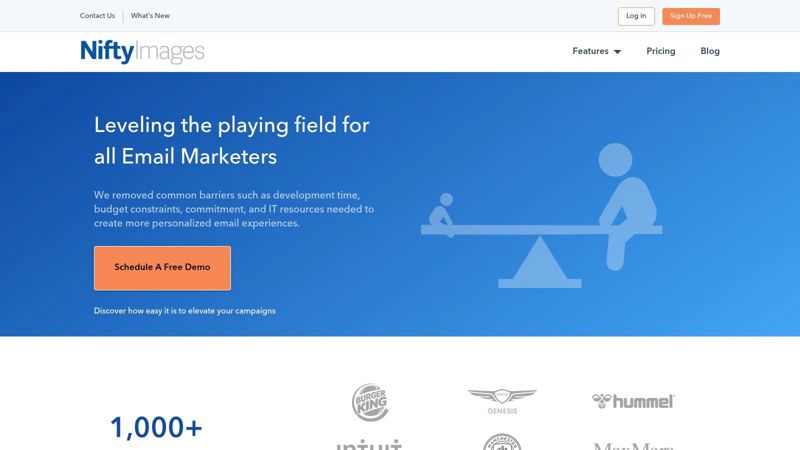
The platform’s standout quality is its deep integration with email marketing merge tags. Instead of complex API calls, users can simply construct an image URL that includes their ESP’s merge tags, such as {{first_name}}. When a recipient opens the email, NiftyImages fetches the personalized data from the URL and generates the image on the fly. This method works well with major ESPs and requires minimal technical setup.
Key Features and Implementation
- Live Email Widgets: Beyond static text personalization, NiftyImages offers dynamic countdown timers, personalized maps showing a user's location, and live social feeds.
- ESP-Friendly Integration: Implementation relies on building an image URL with ESP-specific merge tags, which is much simpler than a full API integration for many marketers.
- Interactive Elements: The platform supports creating rule sets to display different images based on time zones, dates, or device types, and even offers basic in-email polls.
Pricing and Use Cases
NiftyImages' pricing is based on image opens, starting at $20/month for up to 50,000 monthly opens. This model is cost-effective for targeted campaigns but can become unpredictable for large-scale or viral email sends where open counts might spike. Its specialization in email makes it less of a general-purpose tool compared to API-first competitors. However, for marketers who want to add timers, maps, or rule-based images to their emails without writing code, NiftyImages provides an accessible and effective solution. You can explore its features at https://niftyimages.com.
4. Hyperise
Hyperise positions itself as an all-in-one personalization platform for outbound funnels, extending beyond simple images. It combines dynamic image generation with website and video personalization, making it a powerful choice for sales teams and agencies focused on LinkedIn, cold email, and social direct messaging. Its focus on the entire outreach funnel helps it stand out among other best dynamic image generation tools.
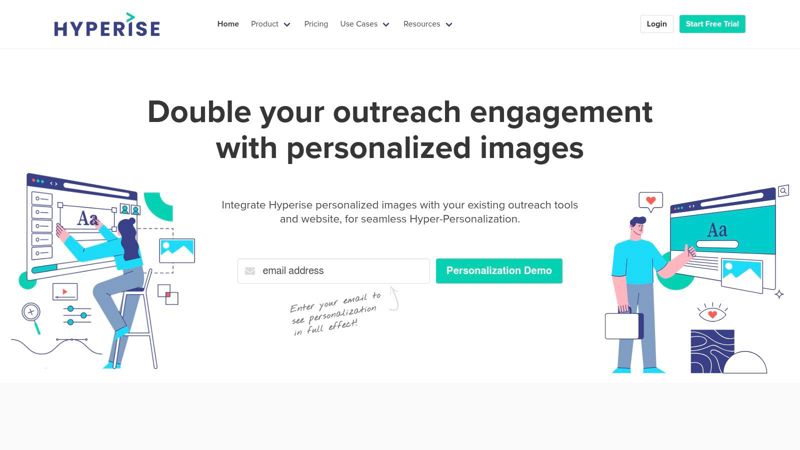
The platform is designed around improving engagement in sales and marketing sequences. Users can create images that pull in a prospect's name, company logo, or profile picture and embed them directly into emails or social messages. A key differentiator is its ability to also personalize website landing pages for those who click through, creating a consistent, personalized journey from first touch to conversion.
Key Features and Implementation
- Multi-Channel Personalization: Create dynamic images, personalized website experiences, and customized videos from a single platform.
- Extensive Template Library: Provides a large library of pre-built image templates designed for specific outbound use cases like LinkedIn messages or email signatures.
- Agency and White-Label Tiers: Offers specific plans for agencies to manage client accounts or resell the service under their own brand.
- Custom Domains: Use your own domain for image URLs to maintain brand consistency and improve deliverability.
Pricing and Use Cases
Hyperise uses a seat-based pricing model, starting at $99/month per seat, which includes a quota of 5,000 views (impressions). This structure is well-suited for solo operators or small sales teams running targeted campaigns. However, the per-seat cost and view limits can become a factor for larger organizations, requiring careful monitoring to avoid overages. Its strong focus on outbound sales and reseller-friendly options make it a go-to for B2B agencies and growth marketers. You can learn more at hyperise.com.
5. Abyssale
Abyssale is a creative automation platform that excels at generating large-scale ad campaign variants. It uses an AI-assisted template system to produce images, GIFs, and even HTML5 assets, making it a powerful choice for performance marketing teams who need to test multiple creative formats across different channels. Its ability to generate assets from a simple spreadsheet or via dynamic URLs makes it one of the best dynamic image generation tools for high-volume advertising.
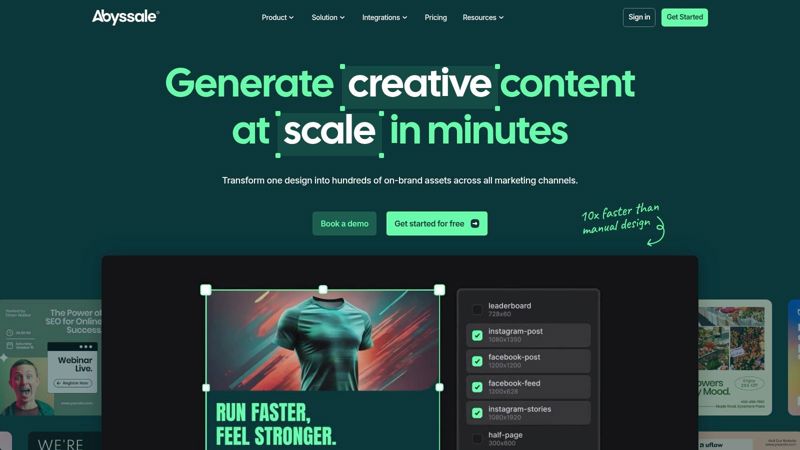
The platform's standout feature is its AI auto-resize and design adaptation, which automatically adjusts a master creative to fit various ad specifications without manual intervention. This is particularly useful for agencies running campaigns on Google, Facebook, and Instagram simultaneously. For programmatic access, Abyssale offers a robust API and standard no-code integrations with Zapier, Make, and Airtable, catering to both developers and marketers.
Key Features and Implementation
- AI-Assisted Design: Automatically resizes and adapts creatives for different formats, checking against common ad network specifications.
- Bulk Generation: Create thousands of image variations by connecting a spreadsheet (CSV) or using dynamic image URLs.
- Multi-Format Output: Generates static images (PNG/JPG), animated GIFs, and HTML5 banners from a single design template. This is a great way to use insights from your customer profiles, which can often be built using zero-party data.
Pricing and Use Cases
Abyssale's pricing starts at $49/month for the "Create" plan, which is limited to static image exports and aimed at individuals. The "Scale" plan, at $199/month per seat, unlocks the API, bulk generation, and animated formats. The credit system for animated and HTML5 assets on higher tiers requires careful management for large-scale video campaigns. While the seat-based model can become expensive for larger teams, its strong bulk-generation workflows make it an excellent choice for creating ad variations at scale.
6. Placid
Placid is a creative automation toolkit designed for generating dynamic images, videos, and PDFs. It offers a powerful combination of a template editor, robust APIs, and numerous no-code integrations, making it an excellent choice for businesses that need to produce on-demand social previews, e-commerce assets, and other personalized visuals at scale. Its flexibility appeals to both developers and marketers looking for an efficient workflow.
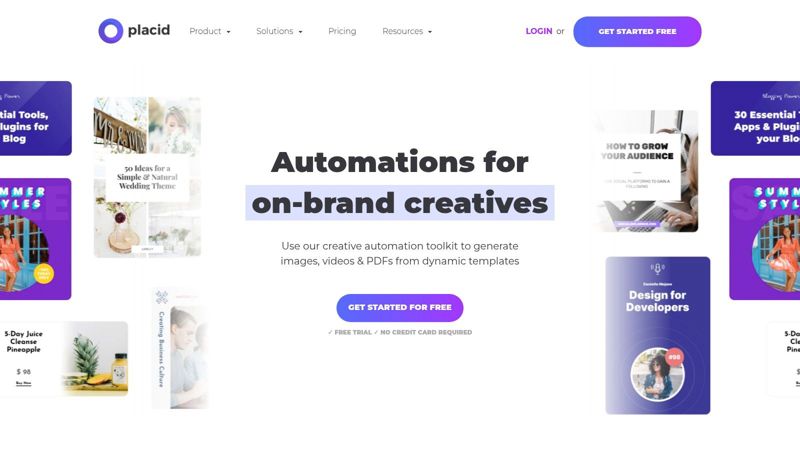
The platform distinguishes itself with developer-friendly features like both a REST API and a URL-based Image API, alongside deep integrations for non-technical teams using Zapier, Make, Webflow, and WordPress. Placid is one of the best dynamic image generation tools for teams that need to test extensively before committing resources, thanks to its unlimited preview mode that doesn't consume credits.
Key Features and Implementation
- Dual API Approach: Provides a REST API for complex jobs and a simpler Image URL API for quick, on-the-fly modifications.
- High-Resolution Support: Capable of generating images up to 16k pixels, which is ideal for print or high-quality digital displays.
- Generous Previews: Offers unlimited, watermarked previews, allowing users to perfect templates and integrations without worrying about costs. It also has dedicated SDKs for mobile app integration.
Pricing and Use Cases
Placid’s pricing begins at $49/month for 5,000 credits, with credit rollover up to two times the monthly budget, offering good value and flexibility. It's well-suited for creating dynamic Open Graph images, personalized marketing assets, and automated product visuals. While its image capabilities are strong, the video generation is capped at Full HD (1080p), and access to the mobile SDK is limited on lower-tier plans, which could be a consideration for certain projects.
7. APITemplate.io
APITemplate.io is a balanced, template-based service for generating dynamic images and PDFs. It is particularly well-suited for businesses that need to produce both marketing graphics and official documents, such as event tickets, personalized certificates, or branded invoices. Users design their master visuals in a drag-and-drop editor and then generate variations through a REST API, direct URL parameters, or no-code integrations.
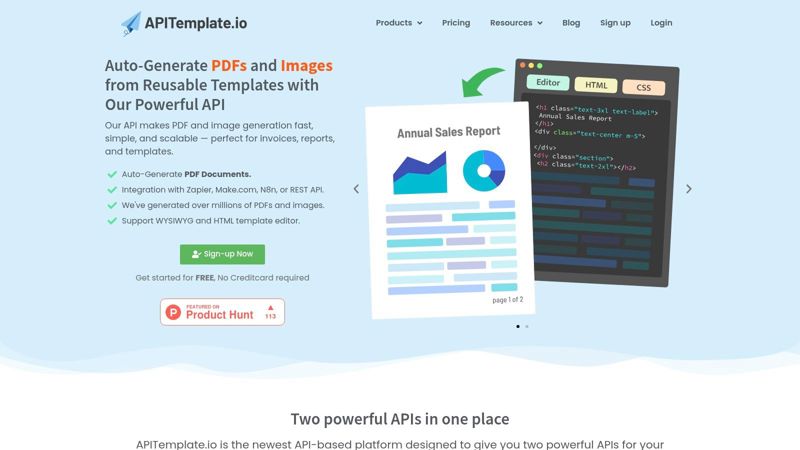
The platform’s strength is its dual focus on image and PDF generation from a single tool. The REST API is straightforward, and for those avoiding code, its integrations with Zapier, Make, n8n, and Airtable make automation accessible. This positions APITemplate.io as one of the best dynamic image generation tools for teams that need a multipurpose solution without the complexity of an enterprise-level system.
Key Features and Implementation
- Dual Image and PDF Editors: Offers a drag-and-drop editor for images and both a visual WYSIWYG and an HTML-based editor for creating dynamic PDFs.
- Flexible Generation Methods: Supports generation via REST API, simple URL modifications, and a wide array of popular no-code platforms.
- Built-in Asset Libraries: The editor includes access to Unsplash and Pexels for stock photos, along with a large selection of fonts for easy design.
Pricing and Use Cases
APITemplate.io provides a generous free plan that allows for 50 images/PDFs per month, making it excellent for prototyping and small projects. Paid plans are structured around a simple credit-based system, starting at $19/month for 1,000 credits, with team support available on higher tiers. The service is a great fit for generating social media graphics, event badges, and personalized documents. However, it is not designed for heavy video or animation workflows and has fewer advanced collaboration features compared to enterprise digital asset management (DAM) platforms.
8. DynaPictures
DynaPictures is a dynamic image generation API built with a strong focus on marketing operations and automation. It allows users to generate personalized visual assets through multiple methods, including URL parameters, a REST API, and no-code integrations. Its template-based system supports advanced features like smart cropping and multilingual text, making it a valuable tool for teams creating event tickets, certificates, and other data-driven marketing collateral.
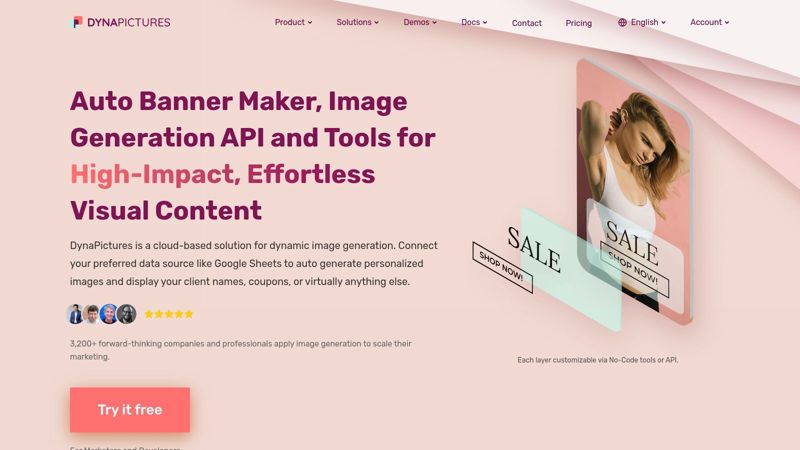
The platform’s strength is its versatility, catering to both developers and non-technical users. You can generate images directly from a spreadsheet, connect to forms, or use integrations with Zapier, Integrately, and Pabbly to automate workflows. The inclusion of multi-tenant workspaces is a practical feature for agencies managing creative assets for multiple clients from a single account.
Key Features and Implementation
- Advanced Image Manipulation: Includes AI face detection for smart cropping, 3D/isometric transforms, and built-in chart generation.
- No-Code and API Options: Supports generation via URL parameters, REST API with webhooks, or spreadsheet and form connections.
- Multilingual and Emoji Support: A key differentiator for global campaigns, ensuring text with special characters and emojis renders correctly.
Pricing and Use Cases
DynaPictures' pricing is configured based on plan and volume, with specific costs provided in ranges rather than fixed upfront tiers. This requires contacting their sales team for a precise quote. A potential drawback is the shorter default image retention period on lower-tier plans, which may affect long-term campaigns. Its feature set makes it one of the best dynamic image generation tools for creating personalized event passes, sales leaderboards, and multilingual social media posts. You can learn more at dynapictures.com.
9. Creatomate
Creatomate is a media automation platform with a strong focus on video generation that also provides a highly capable pipeline for dynamic images. It operates on a template-based model where users design master visuals in a powerful editor and then use its REST API or no-code integrations to produce countless variations. This makes it one of the best dynamic image generation tools for teams that need both scalable video and image outputs from a single, unified system.
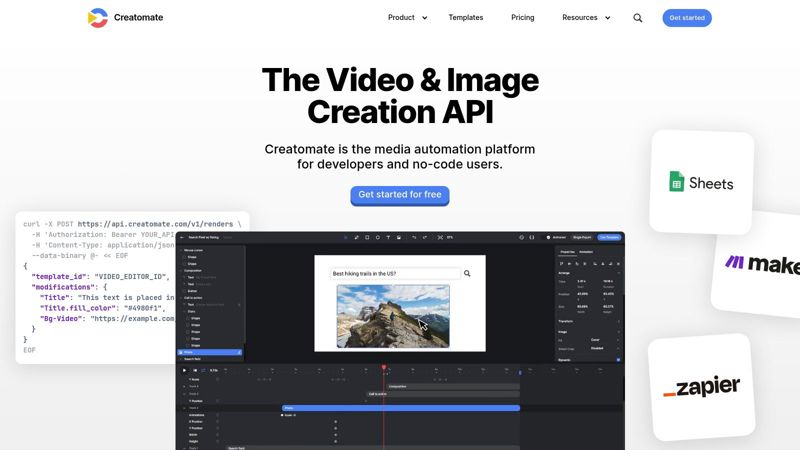
The platform’s standout feature is its video-first architecture, which extends to its image capabilities, allowing for complex compositions and animations that can be rendered as either format. Developers will appreciate the robust REST API and the JavaScript Preview SDK, which allows for building in-app previews of generated media before committing to a full render. For no-code users, Creatomate connects with tools like Zapier and Make and can use feeds from spreadsheets for bulk generation tasks.
Key Features and Implementation
- Video-Centric Tooling: The editor includes a timeline, keyframes, and support for subtitles, which can be applied to complex image compositions.
- Developer-Friendly SDK: A JavaScript Preview SDK enables the creation of real-time in-app previews for a better user experience.
- Clear Credit Model: The pricing is transparent, with one credit per image render, while video costs scale predictably based on resolution, framerate, and duration.
- Bulk Generation: Directly connect spreadsheets or JSON data sources to your templates to produce thousands of unique images or videos at once.
Pricing and Use Cases
Creatomate’s pricing begins with a free plan that includes 25 credits. Paid plans start at $30/month for 300 credits. The structure is ideal for organizations that foresee a need for both dynamic images and videos, as it provides a single stack for both. However, if your only requirement is static image generation, the platform's video-centric features might be excessive. Renders are also automatically deleted after 30 days unless you are on a plan that includes managed storage.
10. Cloudinary (Transformation URLs)
Cloudinary is an enterprise-grade media management platform with a powerful URL transformation API that excels at on-the-fly personalization and optimization. Rather than using a visual template editor, Cloudinary generates dynamic images by manipulating parameters directly in the image URL. This developer-centric approach makes it one of the best dynamic image generation tools for companies needing reliable, scalable, and secure media transformations built directly into their applications.
Its core strength is the rich transformation grammar that allows for complex operations like adding text overlays, watermarks, and compositing multiple images via URL strings. Combined with a global CDN, it delivers optimized, personalized assets with extremely low latency. The platform also offers robust security features like signed URLs, preventing unauthorized users from altering your images or running up your costs.
Key Features and Implementation
- URL-Based Transformations: Modify images in real-time by changing URL parameters for resizing, cropping, effects, and quality optimization.
- Dynamic Overlays and Text: Add dynamic text layers, images as watermarks, or even face-aware overlays directly through the URL structure.
- Signed URLs for Security: Generate secure, authenticated URLs that prevent parameter tampering, which is critical for protecting assets and managing costs.
- Extensive SDKs: Cloudinary provides SDKs for most popular programming languages (Python, Node.js, PHP, Ruby), simplifying the process of building transformation URLs programmatically.
Pricing and Use Cases
Cloudinary operates on a credit-based model, with a generous free tier that includes 25 credits. Paid plans start at $99/month for 225 credits. Credits are consumed based on transformations, storage, and bandwidth, which can make cost forecasting complex for high-volume use cases. Its reliability and performance are top-tier, making it ideal for large-scale e-commerce, media sites, and SaaS applications where media delivery is mission-critical. However, its developer-first nature means it lacks the simple visual template builder that marketing teams might prefer.
11. ImageKit.io
ImageKit.io operates as a real-time image and video optimization and transformation CDN rather than a traditional template-based generator. Its power comes from manipulating media via simple URL parameters, making it an excellent choice for developers who need to dynamically resize, crop, overlay, and optimize assets directly on their websites and applications. The platform can bolt onto existing storage solutions, acting as an intelligent media proxy with a global CDN.
While it's not a drag-and-drop editor, its developer-centric approach makes it one of the best dynamic image generation tools for performance-focused applications. The addition of AI extensions for tasks like background removal, smart cropping, and generative fill adds a new layer of programmatic creative control, allowing for complex edits that would otherwise require manual intervention or a separate service.
Key Features and Implementation
- URL-Based Transformations: Nearly all manipulations, including text and image overlays, are controlled through URL parameters. This makes implementation straightforward in any coding environment.
- AI and Generative Extensions: Provides AI-powered features like background removal and generative fill, which are billed separately as extension units.
- Multiple Origins: Can fetch original media from various sources, including AWS S3, Google Cloud Storage, or any web server, and then optimize and deliver it.
Pricing and Use Cases
ImageKit.io offers a generous free forever plan with 20GB of bandwidth per month. Paid plans are primarily based on bandwidth usage, starting at $49/month for 40GB, with options for storage add-ons. AI features are priced per "extension unit," adding some complexity to billing. It’s ideal for e-commerce sites needing real-time product image variations or apps that require on-the-fly media optimization. The lack of a visual template studio makes it less suitable for marketers who prefer a no-code interface.
12. RenderForm
RenderForm is a lightweight, developer-first tool focused on speed and simplicity for creating personalized images and PDFs. It operates through a straightforward API that converts templates into unique visuals, making it an excellent choice for generating transactional email assets, social media cards, or any application where low-latency rendering is a priority. The platform’s efficiency and affordable pricing make it a compelling option for startups and developers.
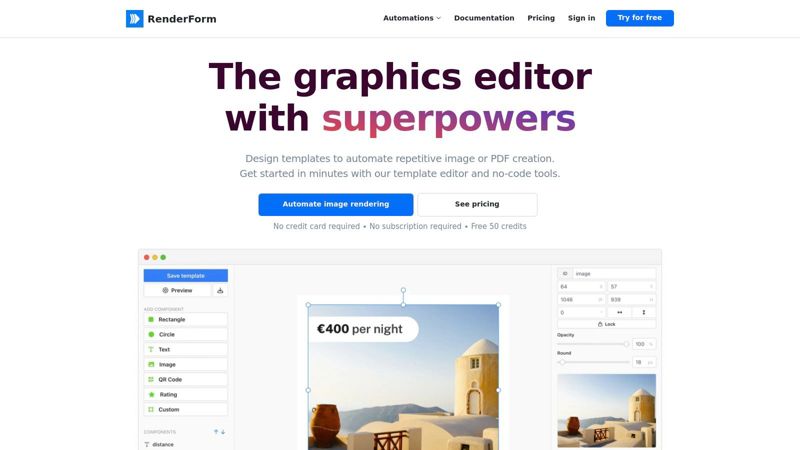
The service provides two distinct paths for template creation: a visual drag-and-drop editor for quick designs and an HTML/CSS editor for those who prefer to build templates with code. This dual approach accommodates both designers and developers. Its API is designed for instant rendering with caching, ensuring that frequently requested images are served immediately, which is a significant benefit for high-traffic applications.
Key Features and Implementation
- Dual Template Editors: Users can choose between a simple visual builder or an advanced HTML/CSS editor for complete creative control.
- Instant Rendering & Caching: The API is optimized for speed, delivering images quickly and caching results to reduce load times for repeat requests.
- No-Code Workflows: Integrations with Zapier and Make allow non-developers to connect RenderForm to hundreds of other apps for automated image creation.
- Developer Tools: Offers a REST API, command-line interface (CLI), and webhooks for versatile integration into different development environments.
Pricing and Use Cases
RenderForm's pricing is one of its main draws, offering a free tier and very affordable pay-as-you-go or low-cost monthly plans starting at just $9/month for 2,000 credits. This makes it one of the most accessible dynamic image generation tools for projects with tight budgets. The straightforward credit model and watermark-free outputs on paid plans provide great value. While it may lack the advanced enterprise features of larger platforms, its speed and cost-effectiveness make it ideal for developers needing a quick, reliable image generation API.
Top 12 Dynamic Image Generators — Feature Comparison
| Product | Core features | UX & reliability | Value & pricing | Target audience | Unique selling points |
|---|---|---|---|---|---|
| 🏆 OKZest | Drag-&-drop editor + REST API; real-time per-open personalized images; analytics; team workspaces | ★★★★☆ Real-time updates; 99% ESP compatibility | 💰 Free trial (2.5k watermarked/mo) → scalable enterprise tiers | 👥 Email marketers, agencies, sales, events, coaches | ✨ Real-time per-open images, easy single-URL email integration |
| Bannerbear | Templates for images/video/PDF; sync/async API; CDN delivery | ★★★★☆ Stable API & logging | 💰 Credit model; URL features on higher tiers | 👥 Marketers, devs, ecommerce teams | ✨ Video/PDF support + no-code integrations |
| NiftyImages | Per-open personalized images; countdowns, calendars, widgets | ★★★★☆ Email-first, reliable open-time renders | 💰 Per-open billing (ESP embeds) | 👥 Email marketers, agencies | ✨ Live email widgets & merge-tag friendly |
| Hyperise | Image, website & video personalization; templates; white-label | ★★★★☆ Strong outbound reliability; view quotas | 💰 Seat-based + view limits; agency tiers | 👥 Sales/outbound teams, agencies | ✨ Multi-channel personalization & white-label options |
| Abyssale | AI auto-resize; spreadsheet bulk generation; video/GIF | ★★★★☆ Good for bulk campaigns & format adaptation | 💰 Credit/seat model; suited for ad specs | 👥 Agencies, advertisers, social teams | ✨ AI-assisted resizing and multi-format automation |
| Placid | Image REST API & Image URL API; high-res up to 16k; many integrations | ★★★★☆ Generous previews; stable for high-res needs | 💰 Credit rollover and preview-friendly pricing | 👥 Devs, social/ecomm, designers | ✨ High-res exports + unlimited preview workflows |
| APITemplate.io | Drag-&-drop image editor + visual/HTML PDF editor; CDN on paid plans | ★★★★☆ Simple & scalable for image+PDF workflows | 💰 Generous free plan; simple credit tiers | 👥 Document/certificate creators, marketers | ✨ Combined image + PDF generation in one tool |
| DynaPictures | URL params, REST API, face detection, charts, multilingual support | ★★★★☆ Feature-rich for marketing ops | 💰 Volume-based plans (ranges); retention limits | 👥 Marketing ops, multilingual campaigns, agencies | ✨ AI face detection, smart cropping, built-in charts |
| Creatomate | Video-first templating with image pipeline; Preview SDK | ★★★★☆ Clear credit math; reliable previews | 💰 Credit model (video scales by res/duration) | 👥 Teams needing video + images | ✨ Robust video + subtitle/timeline support |
| Cloudinary | URL transforms, overlays, dynamic text, SDKs & global CDN | ★★★★★ Enterprise-grade delivery & caching | 💰 Enterprise pricing; complex but powerful | 👥 Large enterprises, platforms, dev teams | ✨ Rich transformation grammar & signed URL security |
| ImageKit.io | URL-parameter transforms, optimization, AI background removal | ★★★★☆ Easy integration; bandwidth-based plans | 💰 Bandwidth/storage pricing; AI units extra | 👥 Web/dev teams, apps, media-heavy sites | ✨ Generative AI extensions + origin/CDN flexibility |
| RenderForm | REST API, CLI & webhooks; visual & HTML editors; instant caching | ★★★★☆ Fast, lightweight & quick to integrate | 💰 Affordable pay-as-you-go & low-cost subs | 👥 Startups, transactional/email asset creators | ✨ Pay-as-you-go with instant rendering & caching |
Choosing the Right Tool to Elevate Your Visual Strategy
We've explored a dozen of the best dynamic image generation tools, each offering a unique approach to transforming your visual content from static and uniform to personalized and impactful. The journey through platforms like Bannerbear, NiftyImages, and Creatomate reveals a clear trend: personalization at scale is not just possible, it's essential for cutting through the noise. Gone are the days when a one-size-fits-all image could capture the attention of a diverse audience.
The key takeaway is that the "best" tool is entirely dependent on your specific context, technical comfort level, and strategic goals. What works for a high-volume marketing agency requiring robust API access might be overkill for a solo event organizer who just needs personalized social media badges. Your decision-making process should be guided by a clear understanding of your primary use case.
A Quick Recap: Matching Tools to Your Needs
To simplify your choice, consider these core distinctions we've discussed:
- For Email-Centric Personalization: If your world revolves around email campaigns, NiftyImages is a clear starting point. Its deep focus on email-specific features like countdown timers and personalized images for ESPs makes it a specialized and powerful choice.
- For API-First Automation: Developers and agencies building automated workflows will find their match with tools like Bannerbear, Abyssale, or Placid. Their robust APIs and extensive integration options (like Zapier and Make) are built for creating thousands of image variations programmatically.
- For Sales and Outreach: Teams focused on personalizing sales outreach on platforms like LinkedIn will see immediate value in Hyperise. Its direct integration with outreach tools and focus on individual-level personalization is its main strength.
- For All-in-One Power and Usability: If you need a versatile solution that balances a powerful no-code editor with a solid API and pre-made templates, OKZest stands out. It's designed to be accessible for marketers while providing the depth needed for more complex agency and developer use cases.
Implementation: Key Factors to Consider Before You Commit
Before you subscribe to any service, map out your implementation plan. A fantastic tool is useless if it doesn't fit your existing processes.
- Integration Points: Where do you need the images to appear? Confirm that the tool has direct integrations, a Zapier/Make app, or a well-documented API that works with your CRM, ESP, or other marketing platforms. A simple HTML snippet might be enough for some, while others will need a full API key.
- Workflow and Team Skills: Who will be creating the image templates and managing the campaigns? A tool with a steep learning curve might slow down a fast-moving marketing team. Conversely, a tool that's too simple may frustrate a developer who needs more control.
- Scalability and Pricing: Your needs today might be different tomorrow. Analyze the pricing tiers carefully. Pay attention to the limits on image generations, API calls, and templates. A low-cost entry plan might become expensive as your campaigns grow.
Making a deliberate choice requires you to look beyond just features. It means assessing how a tool will integrate into your daily operations and support your growth. To truly elevate your visual strategy and streamline content production, exploring various AI content creation tools, which can generate dynamic images, is a crucial step. Ultimately, adopting one of the best dynamic image generation tools is an investment in building stronger, more personal connections with your audience, one image at a time. The right platform will not only save you countless hours of manual design work but will also unlock new possibilities for engagement you haven't yet imagined.
Ready to put these concepts into practice with a tool that balances power and ease of use? OKZest offers a flexible platform perfect for marketers, agencies, and developers alike. Start creating stunning, personalized images in minutes with our intuitive editor or automate your entire workflow with our robust API. Sign up for OKZest today and see how simple dynamic imaging can be.