Level Up Your Credentials with the Perfect Certificate Creation Software
Want to design professional-looking certificates without wrestling with clunky templates? This guide covers eight certificate creation tools for 2026, suited to everyone from email marketers and event organizers to recruiters and coaches. We compare OKZest, Canva, Adobe Express, Certifier, Certificate Magic, Fotor, Credly and Diploma Designer, covering options for a range of budgets and needs.
Looking for a certificate of merit specifically?
A quick clarification, because the terms get mixed up. A certificate of merit is a type of award - recognition for a particular standard of performance, commonly used in schools, competitions and workplace recognition programmes. It is a document, not a tool.
If you want to make one, any of the software below will do it, and our free certificate generator will produce one in about thirty seconds with no account.
If you want to know what should go on one - the wording, the signatory, whether "merit" is even the right term for what you are recognising - our guide to what to put on a certificate covers that. Worth two minutes, because "merit" implies a judged standard, and using it where nothing was assessed weakens the award.
Everything below is about the software.
1. OKZest: Personalized Certificates at Scale
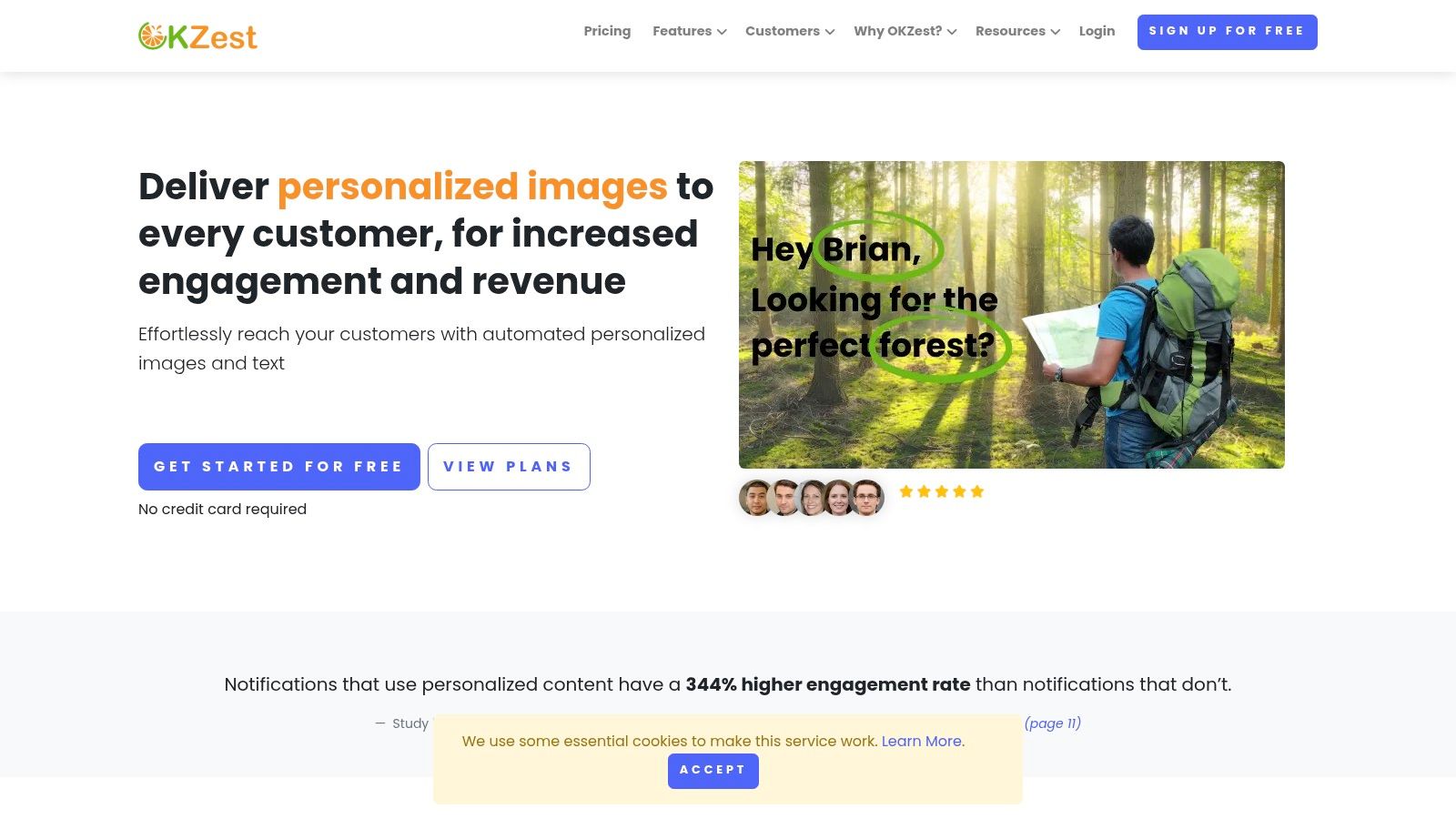
OKZest is an image personalization platform, and certificates are one of the things it handles well. Rather than producing one design at a time, it generates a different version of the same design for every recipient - name, achievement and date built into the certificate automatically, without coding.
That approach extends beyond certificates to personalized email headers, social graphics, website banners and more, which makes it useful to email marketers, social media managers and event organizers as well as anyone issuing credentials. The shorthand is "merge tags for images": you inject personalized data directly into a visual.
It works with any email platform that supports custom image URLs and merge tags, including Mailchimp, Klaviyo, HubSpot and ActiveCampaign. That means a personalized certificate can be embedded directly into a campaign rather than attached as a file or linked externally.
Support for both static and live data adds another dimension - a certificate can carry a reference number generated at issue time, or a figure pulled from your own system. Fallback default values ensure a certificate still renders properly when a data field is missing for a particular recipient, which matters when your source data is a spreadsheet other people filled in.
Implementation tips:
- Start with one field. Personalize a name or date before attempting anything elaborate.
- Use a template as a base rather than designing from scratch.
- Connect your data source - spreadsheet, form or API - once the design is settled.
- Test with your longest real names before generating a batch.
Pros:
- No-code editor and API, so it suits both marketing and engineering workflows
- Works with any email platform that accepts a custom image URL
- Dynamic data with fallback defaults
- Tiered pricing from a free plan through to team and enterprise tiers
- Team collaboration with role-based permissions and project separation
Cons:
- Higher volume and advanced collaboration features require paid tiers
- Images render on request, so there is a brief generation step
- Not a print design tool - for elaborate one-off artwork, dedicated design software gives more control
OKZest suits anyone issuing certificates repeatedly rather than occasionally. If you need one beautiful certificate, a design tool is simpler; if you need four hundred with different names on them, this is the category that solves it. For the mechanics, see generating certificates automatically.
Website: https://okzest.com
2. Canva
Canva is a versatile and widely popular online design platform that has become a go-to for visually appealing certificates. Its extensive template collection and intuitive drag-and-drop interface suit a diverse range of users, from educators and businesses to individuals designing professional-looking awards - academic achievements, professional certifications, participation awards, or gift certificates.
Canva's biggest strength is a library of over 1,000 customizable certificate templates, professionally designed and covering many styles. That removes the need to start from scratch, which matters most for users without design experience. The drag-and-drop interface makes customization straightforward, and real-time collaboration helps teams work on designs together.
For organizations concerned with brand consistency, the Brand Kit stores logos, colors and fonts so certificates align with established identity - useful for agencies, sales teams and consultants maintaining a cohesive image. Bulk creation and mail merge help event organizers, recruiters and educators generate large numbers of certificates efficiently, and integration with Google Classroom streamlines awarding in educational settings.
Canva offers both free and paid options. The free tier provides substantial templates and features, viable for individuals and small businesses. Premium unlocks the full template library, premium design elements, brand kit and bulk creation.
Considerations: compared with professional design software, Canva's advanced design capability is limited, so highly specialized or intricate designs may feel restricted.
Website: https://www.canva.com
3. Adobe Express
Adobe Express brings professional templates, Adobe Fonts and Adobe Stock into a template-based editor. It suits users who want polished results with access to genuinely high-quality assets, and it is a natural fit for teams already working inside the Adobe ecosystem.
The typography options are a meaningful differentiator - certificates are text-led documents, and font quality shows. Brand Kit support keeps designs consistent across an organization.
Considerations: a steeper learning curve than the simplest tools, and full access to assets and advanced features requires a subscription.
Website: https://www.adobe.com/express
4. Certifier
Certifier is a digital credentialing platform rather than a design tool. It handles issuing, managing, tracking and verifying certificates and badges, with verification features that let third parties confirm a credential is genuine.
That makes it appropriate for educational institutions, corporate training programmes and professional bodies - anywhere the credential needs to withstand scrutiny rather than simply look good. Automated workflows handle bulk issuance.
Considerations: higher cost with an enterprise focus, and setup is more involved than a simple generator.
Website: https://certifier.io
5. Certificate Magic
Certificate Magic focuses on bulk generation with mail merge and database integration. It offers precise layout control and supports both print and digital output, which suits schools, event organizers and training groups issuing certificates in volume.
Considerations: the interface is dated compared with newer platforms, though it remains functional and cost-effective for bulk work.
6. Fotor
Fotor combines certificate templates with photo editing and AI-assisted design suggestions, in an intuitive editor with a mobile app. It suits personal users and small businesses wanting a quick, capable tool without a steep learning curve.
Considerations: the template library is smaller than dedicated certificate platforms, and AI suggestions vary in usefulness.
Website: https://www.fotor.com
7. Credly
Credly focuses on digital badges and skills mapping, with LinkedIn sharing built in. Rather than producing a document, it issues a verifiable credential tied to specific competencies that recipients can display on professional profiles.
That makes it a strong fit for corporations, educational institutions and professional organizations where the credential's portability and verifiability matter more than its appearance.
Considerations: premium pricing oriented toward organizations rather than individuals.
Website: https://info.credly.com
8. Diploma Designer
Diploma Designer specializes in academic certificates and diplomas, with multilingual support, security features including watermarking, and batch processing. It is purpose-built for educational institutions.
Considerations: a specialized and somewhat older interface, sold as software rather than a subscription service.
Certificate Creation Software Compared
| Platform | Core Features | Experience | Value & Pricing | Best For | Distinctive |
|---|---|---|---|---|---|
| OKZest | No-code editor and API for dynamic personalized images | Easy integration; scalable | Free plan through to enterprise tiers | Marketers, agencies, sales, coaches | Merge tags for images; team roles and projects |
| Canva | Drag-and-drop; 1,000+ templates | Beginner-friendly | Free plus Premium subscription | Individuals, educators, small businesses | Huge template library; Google Classroom integration |
| Adobe Express | Professional templates, Adobe Fonts and Stock | Powerful; steeper learning curve | Free plus subscription | Designers, professionals | Adobe ecosystem; advanced typography |
| Certifier | Verification, digital badges, automated workflows | Secure and compliant | Higher cost, enterprise focus | Educational institutions, corporate training | Credential verification |
| Certificate Magic | Bulk mail merge, database integration | Functional, dated interface | Cost-effective for bulk use | Schools, event organizers, training groups | Precise layout control; print and digital |
| Fotor | AI-assisted design, photo editing, mobile app | Intuitive | Free plus subscription | Personal users, small businesses | AI design suggestions; mobile-friendly |
| Credly | Digital badges, skills mapping, LinkedIn sharing | Industry leading | Premium pricing | Corporations, educational bodies | Open Badges standard; professional networking |
| Diploma Designer | Academic templates, multilingual, security | Specialized, older interface | Software purchase | Educational institutions | Watermarking and batch processing |
Choosing the Right Certificate Creation Software
Eight tools, and they are not really competing with each other - they solve different problems. The useful question is which problem you have.
You need one certificate, occasionally. A design tool, or a free generator. There is no reason to evaluate software for a single award.
You need attractive certificates, produced by hand. Canva or Adobe Express. Both give you good design with a low learning curve, and Adobe wins on typography if the certificate is text-heavy.
You need many certificates, repeatedly, in your branding. This is where a personalization platform like OKZest earns its place - the setup happens once, and every subsequent batch is free of manual work.
You need certificates that can be verified. A design tool cannot do this. Certifier or Credly issue credentials with verification built in, which matters for accredited training and professional bodies.
You need academic diplomas at institutional scale. Diploma Designer is purpose-built for it.
A note on content rather than software. Whichever tool you choose, what the certificate says matters as much as which platform made it. "Certificate of Completion" and "Certificate of Achievement" mean different things, and details like a reference number or issue date are what make a certificate credible to whoever reads it next. Our guide to what to put on a certificate covers the conventions.
Evaluating OKZest for your team? See pricing and plans for volume, team features and role-based access, or book a call to talk through your certificate volumes and workflow.
Want to try it first? Create a free account - no credit card required - or read generating certificates automatically for how the spreadsheet, form and API workflows fit together.