At its core, personalized image automation for enterprise is technology that lets businesses automatically create unique, data-driven visuals for every single customer. It's a huge leap from the old way of doing things—using the same generic, one-size-fits-all imagery for everyone—to creating dynamic, one-to-one visual conversations that actually grab attention and get people to act.
The End of One-Size-Fits-All Enterprise Marketing

For a long time, big-company marketing was like shouting through a megaphone. You’d craft one message, one ad campaign, or one email banner and hope it resonated with as many people as possible in a huge, faceless crowd. The static, generic images used were the visual equivalent of this approach: totally impersonal and incredibly easy to tune out.
In a world drowning in content, that megaphone approach just doesn't cut it anymore. Today's customers don't just prefer personalization; they flat-out expect it. In fact, research shows that 80% of consumers are more likely to buy from a brand that gives them a personalized experience. That fundamental shift in expectations signals the end of the one-size-fits-all era.
From Megaphones to Personal Conversations
This is where personalized image automation becomes a complete game-changer for enterprise businesses. Instead of shouting at everyone, this technology lets you have a quiet, one-on-one conversation with each customer, using images as your language.
Think about a loyalty program email. The generic version would show a boring stock photo of a coffee cup. But a personalized approach could feature an image with the customer's name, their exact loyalty points balance, and even a picture of their favorite drink. That small change turns a forgettable email into a meaningful, personal touchpoint.
The core idea is simple but incredibly powerful: treat every customer like an individual. Personalized image automation is the engine that lets large companies do this across millions of customer interactions without any manual work.
This technology is the bridge between all the rich customer data you have and your visual communications. It gives your marketing, sales, and support teams the power to create genuine moments of connection that build real, lasting loyalty.
Why Visual Personalization Is a Necessity
In a crowded market, personalizing your visuals isn't just a "nice-to-have" feature—it's critical for survival and growth. Static images simply fail to catch the eye of an audience that's used to seeing hyper-relevant content everywhere they look. Companies that stick with the old way risk becoming completely invisible.
By embracing personalized image automation, you can:
- Boost Engagement: Dynamic visuals that include personal details are far more likely to get noticed, clicked, and acted on.
- Increase Conversions: When you present tailored offers and messages visually, you can dramatically improve conversion rates on any channel.
- Strengthen Brand Loyalty: Making customers feel seen and understood fosters a much deeper, more durable connection to your brand.
This isn't just about running better marketing campaigns. It's about fundamentally changing how you talk to your audience, making every single interaction feel relevant and impactful.
How Personalized Image Automation Actually Works
At its core, personalized image automation for enterprise is a lot like a mail merge, but for visuals. Instead of dropping text into a document, you’re merging unique customer data directly into a master image. This lets you create endless, unique variations from a single, well-designed foundation.
Think of it like a beautifully designed digital postcard. This is your master image template. It has a fixed background, your company logo, and specific spots reserved for dynamic content. These spots are like empty boxes, just waiting to be filled with information unique to each person who sees the image.
This is the secret to making personalization work at scale. Instead of asking a design team to create thousands of individual images—an impossible and expensive task—the automation software does all the heavy lifting in milliseconds.
The Core Components of Personalization
To make the magic happen, a few key pieces have to work together perfectly. It’s a coordinated dance between your design assets, your customer data, and the automation engine that links them. The entire process is built for efficiency and reliability, ensuring every visual comes out looking exactly right.
Here's a breakdown of the core elements that make up an effective personalized image automation system.
| Component | Function | Enterprise Value |
|---|---|---|
| Master Template | The visual blueprint. It's a layered image where static elements (logo, branding) are locked, and dynamic layers are ready for personalization. | Ensures brand consistency while allowing for massive creative flexibility. |
| Data Sources | The fuel for personalization. This is your CRM, CDP, or even a simple spreadsheet where customer information is stored. | Connects real-time customer insights directly to your visual communications. |
| Dynamic Layers | The customizable fields within the template. This could be a first name, loyalty points, a recently viewed product, or a unique promo code. | Creates a truly one-to-one connection by reflecting individual customer data. |
| Automation Engine | The software that connects the template to the data source and generates the final, personalized image on the fly. | Drastically reduces manual effort, enabling personalization at an enterprise scale. |
By connecting these elements, you create a simple rule: "For every customer, take their data and place it into the corresponding dynamic layers of this template." You can get a deeper look at the mechanics in our guide on dynamic image generation.
Real-Time Data Integration
The real power of this technology for enterprises is its ability to operate in real-time. When a customer opens an email or loads a webpage, the automation platform pings your data source. It grabs the most current information for that specific user and generates the image instantly.
This means your visuals are always relevant. If a customer’s loyalty status changes, the very next image they see will reflect that update without you having to lift a finger. It guarantees a consistently accurate and personal experience. To get a better handle on the basics, it helps to first understand what is content automation and how it works.
A crucial feature of any enterprise-grade system is the use of "smart fallbacks." This is a safety net that ensures a polished, professional look even when data is missing.
For example, if the system can't find a customer's first name, it can automatically swap in a default value like "Valued Customer" or "A Special Offer for You." This prevents broken-looking images with awkward empty spaces and maintains brand consistency across every touchpoint. It's a small detail that guarantees a high-quality experience every time.
The move toward this kind of sophisticated technology is picking up speed. The global personalization software market is projected to hit USD 5.14 billion by 2030. That rapid growth shows just how critical personalization has become for driving real business results. You can discover more insights about personalization market trends from Startus Insights.
Integrating Visuals into Your Enterprise Tech Stack
Successful personalized image automation for enterprise can't just be another tool operating in a silo. That just creates more work. Instead, it needs to act as a powerful, integrated layer within the technology you already use every day. The secret to making this connection seamless is an API-first approach, which allows all your systems to talk to each other and work together automatically.
Think of an Application Programming Interface (API) as a messenger that lets different software applications communicate. In this context, the API lets your existing platforms—like your CRM or email service provider—request a personalized image on the fly. Your development team can use this to generate millions of unique visuals that fit perfectly into the workflows you already rely on.
This simple flowchart shows how raw data is transformed into a unique visual for each customer. It's a surprisingly straightforward process.
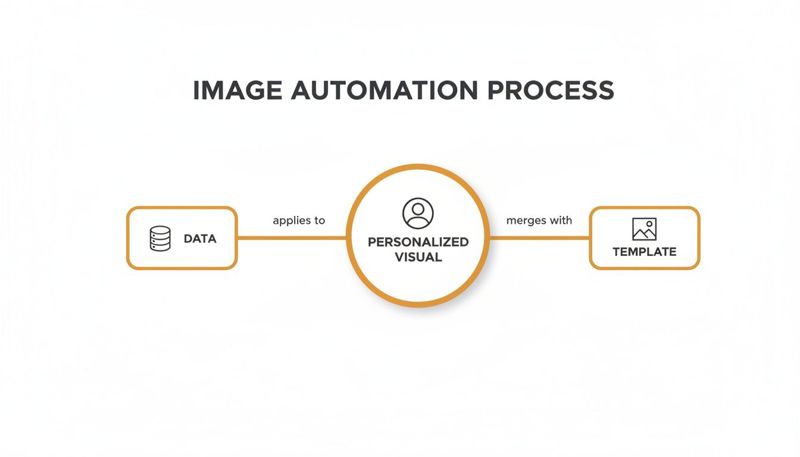
As you can see, customer data from your systems is applied to a pre-designed template, instantly creating a personalized visual experience for the end user.
Connecting with Your Marketing and Sales Tools
The real magic of an API-driven approach is its flexibility. It lets the personalization engine plug directly into the software that powers your customer communications, turning static campaigns into dynamic, one-to-one conversations and unlocking the rich data stored across your organization.
A perfect example is embedding dynamic images directly into your email campaigns. With platforms like Instantly or Klaviyo, this is often as simple as inserting a merge tag into your email template. This tag is just a special URL with placeholders for customer data. When the email goes out, the recipient's email platform automatically fills in their data, requests the unique image, and displays it right in their inbox.
But this integration goes way beyond just email:
- Customer Relationship Management (CRM): By connecting to your CRM, you can pull in detailed customer history—like their last purchase date or lead score—to create highly relevant visuals for sales outreach.
- Customer Data Platforms (CDP): A CDP gives you a unified customer profile. Integrating with it allows you to use comprehensive behavioral and demographic data for hyper-personalization across every channel.
- Marketing Automation Platforms: Trigger personalized images based on specific customer actions, like abandoning a cart or reaching a new loyalty tier, creating timely and impactful interactions.
This level of integration transforms your data from a passive resource into an active asset for creating engaging visual content. If you're looking to get into the technical nitty-gritty, you can explore our detailed API integration tutorial.
Addressing Enterprise-Grade Requirements
For any enterprise, bringing on a new technology means thinking hard about scalability, security, and compliance. A robust personalized image automation solution is built from the ground up to address these critical concerns, ensuring it can perform reliably and safely at massive scale.
Scalability isn't just about handling more users; it's about maintaining performance and reliability as demand grows exponentially. An enterprise-ready platform must be able to generate millions of images per day without a drop in speed or quality.
This is usually handled through a cloud-based infrastructure that can automatically scale resources up or down based on request volume. This elasticity ensures that your campaigns run smoothly, whether they're for a thousand customers or ten million.
Ensuring Security and Compliance
Protecting sensitive customer data is non-negotiable. Period. When your systems send data to the image automation API, that information has to be handled securely. Leading platforms use several layers of protection to ensure data integrity and privacy.
Key Security and Compliance Measures:
- Data Encryption: All data sent between your systems and the image API should be encrypted in transit (using protocols like TLS) and at rest. This prevents anyone from snooping on the data.
- Access Controls: Enterprise tiers often include features like role-based access control (RBAC), letting you decide exactly who on your team can create, edit, or manage image templates and data connections.
- Compliance Certifications: Look for platforms that adhere to major data privacy regulations like GDPR and CCPA. This shows a real commitment to handling data lawfully and ethically.
The broader market trends confirm this strategic shift. The marketing automation market is on track to hit USD 14.5 billion by 2031, and 74% of marketers are already using generative AI for creating content like images. This shows that enterprises are investing heavily in automation and personalization to activate their data, especially as other data sources become less available.
Real-World Enterprise Use Cases That Drive Results

The technical side of personalized image automation is interesting, but seeing it in action is what really makes the lightbulb go on. Let’s look at how big companies are actually using this technology in different departments to hit their goals. It’s about moving past boring stock photos and creating genuine, one-to-one connections.
This isn't just some marketing gimmick; it's a practical tool that adds value across the entire customer journey. Whether you're celebrating a customer milestone or sending out account updates, dynamic visuals can turn a routine message into a memorable experience.
Enhancing Email Marketing and Loyalty Programs
Email is still a workhorse for any enterprise, but getting noticed in a packed inbox feels like a bigger challenge every day. Personalized images can change a standard email campaign into a unique message that’s almost impossible to ignore. For more on this, check out our guide on finding the right enterprise email personalization platform.
Think about a retail brand's loyalty program. Instead of a generic "Thanks for being a member" banner, the system can instantly create a custom image for every single person.
It could include:
- Their first name in a bold, eye-catching font.
- Their current points balance, pulled in real-time.
- A visual of the next reward they’re close to unlocking.
- A picture of a product they recently looked at.
Suddenly, a passive update becomes an interactive, motivating experience. The customer sees their personal status right away and gets a little nudge to take the next step, which helps drive repeat business and builds loyalty.
Key Takeaway: Personalized visuals in emails don't just get you more opens. They seriously boost click-through and conversion rates because the content is immediately relevant and valuable to that specific person.
You can apply the same idea to financial services, where an image might show a personalized progress bar for a savings goal. Or in the travel industry, a banner could display a customer’s frequent flyer status with offers for their favorite destinations. The possibilities are endless.
Scaling Social Media and Direct Outreach
For sales and social media teams, creating personalized content at scale has always been a headache. Nobody has time to manually create custom visuals for hundreds of prospects. This is where image automation comes in, allowing teams to generate unique outreach images in bulk for platforms like LinkedIn or X (formerly Twitter).
Imagine a B2B sales team going after new leads. They can use an automation tool to create an image for each prospect that shows:
- The prospect’s company logo.
- Their name and job title.
- A killer statistic that’s relevant to their industry.
When you include that image in a LinkedIn message, it stands out from all the generic text-based DMs. It proves the salesperson did their homework and respects the prospect's time, making a response far more likely.
Powering Events and Customer Support
Personalized visuals are useful far beyond marketing and sales. Event organizers, for example, can use this tech to automatically create and send personalized certificates of attendance to thousands of people, each with the individual's name and the specific course they completed. You can see the value of interactive visuals at live events with things like photo booths for corporate events, which show how personalization drives engagement.
Even customer support chatbots can get an upgrade. When a customer asks about their order, the bot could show an image with the product they ordered, their name, and a visual timeline of the shipping process. It’s clearer, easier to understand, and feels a lot more human.
To show how this all comes together, let’s look at how these applications impact key business metrics across different departments.
Enterprise Use Case Impact Analysis
| Use Case | Channel | Personalization Example | Primary KPI Impacted |
|---|---|---|---|
| Loyalty Program Updates | Image showing member's name, points balance, and next reward. | Customer Lifetime Value (CLV) | |
| B2B Sales Outreach | LinkedIn, Email | Image with prospect's name, company logo, and an industry stat. | Sales Pipeline Velocity |
| Event Follow-Up | Email, Web | Personalized "Thank You" graphic or certificate of completion. | Attendee Satisfaction (NPS) |
| E-commerce Cart Abandonment | Image of the abandoned item with the customer's name and a special offer. | Conversion Rate | |
| Customer Support | Chatbot, Web | Visual summary of an order status or account information. | First Contact Resolution (FCR) |
| Onboarding Sequence | Email, In-App | Welcome image featuring the user's name and a quick start tip. | User Activation Rate |
By weaving personalized image automation into these different touchpoints, a company ensures that every interaction is an opportunity to build a stronger relationship, provide clarity, and drive the customer to take the next step.
Building Your Enterprise Implementation Roadmap

Successfully rolling out personalized image automation for an enterprise isn't as simple as flipping a switch. It takes a clear, phased approach that starts small to prove its value before scaling up intelligently. A solid roadmap turns a cool idea into a practical, integrated part of your marketing operations, getting key stakeholders on board and ensuring a smooth rollout.
The whole journey kicks off with a focused pilot project. The goal here is simple: show real, tangible results quickly. This creates a strong business case for a much bigger deployment. By zeroing in on one specific use case, you can measure the impact accurately and build the momentum you need for what comes next.
Phase 1: Define Objectives and Secure Your Data
Before a single image gets created, you have to know what success actually looks like. Your initial goals should be specific, measurable, and tied directly to business outcomes. Forget vague goals like "improve engagement." Get specific. Aim for something like, "increase email click-through rates by 15% on our next loyalty campaign."
Next, figure out what data will power all this personalization. That means answering a few key questions:
- What data do you actually need? (e.g., first name, loyalty points, last purchased item)
- Where is this data stored? (e.g., your CRM, a CDP, or a separate database)
- Is the data clean and ready to use? Double-check its accuracy and make sure your team can actually get to it via an API.
This first step is foundational. It makes sure your creative efforts are built on a reliable data strategy. Without clean, accessible data, even the most brilliant templates are going to fall flat.
Phase 2: Design Templates and Run a Pilot
With your goals set and data sources locked in, it’s time for the creative part. The trick is to design versatile master image templates that keep your branding consistent while leaving room for personalization. These templates need designated "dynamic zones" for things like text, user-specific images, or QR codes, while your logo and brand colors stay put.
Once your templates are ready, launch a controlled pilot project. A simple A/B test is perfect for this. Send one segment of your audience the standard static image, and send the other the new personalized version.
Think of a pilot project as your innovation sandbox. It's a low-risk space to test your ideas, measure the direct impact on KPIs, and get crucial feedback before you commit to a full-scale integration.
Monitor the results obsessively. Did the personalized images get more clicks? Did they lead to more conversions? This is the hard data you'll need to justify expanding the program. This kind of strategic investment aligns with where the market is headed. The AI-based image analysis market, which powers this tech, is projected to hit USD 36.36 billion by 2030, with cloud solutions growing the fastest. Discover more insights about the growth of AI-powered visual solutions.
Phase 3: Integrate and Scale Across the Enterprise
After you've run a successful pilot, the last phase is to integrate the solution right into your core marketing stack. This usually means getting your dev team to use the platform’s API to connect it with your main communication tools, like your Email Service Provider (ESP) or marketing automation platform.
This is also where you start thinking about broader enterprise needs. Leading solutions like OKZest come with features built for large teams:
- Team Collaboration: You can set up shared workspaces so different departments can create and manage their own image templates without stepping on each other's toes.
- Role Management: Assign specific permissions to users. This ensures designers can’t accidentally mess with data connections and marketers can’t alter brand-approved templates.
By following this three-phase roadmap—Define, Pilot, and Scale—you can introduce personalized image automation in a structured, methodical way. This approach minimizes risk, proves ROI early on, and builds a strong foundation for transforming your visual communications across the entire company.
Measuring Success and Planning for Growth
Rolling out personalized image automation is a serious investment, and like any big move, you need to be able to measure its impact. To really prove its worth, you have to look past the surface-level numbers and drill down into the Key Performance Indicators (KPIs) that tie personalized visuals directly to your bottom line.
Keeping an eye on these metrics isn't just about justifying the cost. It’s about learning what actually clicks with your audience so you can keep getting better. The end goal is to nail down a clear return on investment (ROI) that shows just how powerful dynamic images are for driving real revenue.
Key Performance Indicators to Track
To build a solid business case, start by watching how users behave right away. These engagement metrics are the first clues that your personalized strategy is hitting the mark.
- Click-Through Rate (CTR): This is one of the most immediate signs of success. An image that calls a customer out by name or shows their loyalty status is always going to grab more attention—and clicks—than a generic stock photo.
- Conversion Rate: Are the people who see personalized images more likely to do what you want them to do? Track whether they follow through on making a purchase, signing up for a webinar, or downloading a guide.
- Customer Lifetime Value (CLV): Over the long haul, these personalized moments build stronger relationships and earn loyalty. If you see the CLV rising for customer segments that get personalized content, you know you're onto something big.
When you can connect personalized image campaigns directly to these core business metrics, the conversation inside your company shifts from "this is a nice-to-have" to "this is a must-have for growing our business."
Planning for Enterprise Scale
So, you've run a successful pilot and the ROI is looking good. What's next? It's time to think about growth. A true enterprise solution has to scale smoothly, going from creating a few thousand images for a test run to pumping out millions per month for global campaigns without breaking a sweat.
This means you need an operational model that’s both sturdy and adaptable. Look for flexible pricing that grows with you, so you can start small and ramp up as your campaigns take off. A scalable, cloud-based infrastructure is non-negotiable—it’s what allows you to handle huge volumes of requests without slowing down. That way, whether you're running a campaign for one brand or ten, the performance stays top-notch.
At the end of the day, personalized image automation is more than a marketing gimmick; it's a strategic asset. By carefully measuring its impact and planning for growth, you can cement its place as a key driver of customer loyalty and business value.
Frequently Asked Questions
When you start digging into personalized image automation for enterprise use, a few big questions always pop up. It's totally normal. Let's tackle them head-on so you have the clarity you need to move forward with confidence.
We want to pull back the curtain on how a serious platform is built to handle the tough demands of a large organization, making sure everything runs smoothly and securely.
How Secure Is Our Customer Data?
This is the big one, and for good reason—data security is completely non-negotiable. Any reputable platform worth its salt will protect your data at every single step. This isn't just a promise; it's baked into the architecture with multiple layers of security to block unauthorized access and keep you compliant.
Here’s what you should expect as a baseline:
- End-to-End Encryption: All data has to be fully encrypted, whether it's flying across the internet to the platform (in transit) or sitting on a server (at rest). This makes the information gibberish to anyone who isn't supposed to see it.
- Compliance with Regulations: The platform must play by the rules. That means strict adherence to major data privacy laws like GDPR and CCPA, ensuring customer data is handled ethically and legally.
- Strict Access Controls: Enterprise-grade tools give you role-based access. You get to decide exactly who on your team can see or touch sensitive data and templates.
These measures work together to ensure that while you're busy creating amazing personalized experiences, your customers' information stays locked down and confidential.
Can It Integrate with Our Complex Tech Stack?
Yes, absolutely. In fact, if it can't, it's not a true enterprise solution. The whole point of a platform like this is to slide right into your existing technology ecosystem. This is usually done through a flexible and well-documented API (Application Programming Interface), which is basically a universal translator for software.
An API-first design means the platform was built from the ground up to talk to other tools, not to live on an island. It gives your developers the power to generate images programmatically from any application you already use, whether it’s your CRM or your own custom-built internal software.
This approach makes personalized image automation feel like a natural part of your current workflow, not some clunky new process you have to force on your team. It just pulls data from the systems you already rely on and uses it to create visuals that are both personal and perfectly timed.
How Does The System Handle High-Volume Demands?
Scalability is everything. An enterprise platform has to be able to crank out millions of unique images without breaking a sweat or slowing down. This is handled by a distributed, cloud-based infrastructure that automatically flexes its muscles to meet demand.
Think of it like this: during a huge campaign or a holiday rush, the system automatically scales up its resources to handle the massive load, making sure every single image gets delivered instantly. When things quiet down, it scales back. This elasticity guarantees you get consistent, reliable performance and a perfect user experience, whether you're serving a thousand customers or ten million.
Ready to see how personalized images can completely change your customer engagement game? With OKZest, you can automate the creation of unique, data-driven visuals for every single customer.
Start creating personalized images at scale with OKZest