Personalized marketing visuals are basically dynamic images that change to show unique info for each person looking at them—think names, locations, or even their purchase history. This approach turns a generic ad into a one-on-one visual conversation, making customers feel like you're speaking directly to them.
It's a lot like a barista writing your name on a coffee cup. That small, personal touch makes a huge difference and creates a real connection.
What Are Personalized Marketing Visuals
Imagine opening an email where an image has your name woven right into it, not just floating in the text. That’s the magic of personalized marketing visuals. If you've ever used merge tags like "Hello, {{FirstName}}" in your emails, this is the exact same idea, but for your graphics.
Instead of blasting the same static image to thousands of people, you can send a unique version to every single recipient. One template can spin off into countless personalized variations, all automatically.
Beyond a Simple Name Drop
But great visual personalization is so much more than just slapping a name on an image. It’s about using customer data to create visuals that are genuinely helpful and relevant. This is a big part of the shift we're seeing with AI in ads, where messages are built from the ground up for each individual. When you use the right data points, your visuals connect on a whole other level.
For instance, a personalized visual could show:
- A customer’s name on a digital event ticket or loyalty card.
- Their company logo mocked up on a B2B sales proposal.
- A picture of a product they were just looking at on your site.
- Their city’s skyline in the background of a special offer.
This kind of detail makes your marketing feel less like a broadcast and more like a helpful, direct chat. It's a fundamental part of a strong visual communication strategy. If you want to dig deeper into the "why," you can learn more about what is visual communication in our detailed guide.
How This Strategy Captures Attention
Let's be honest, we're all drowning in digital noise. Personalization is the best way to break through it all. Our brains are wired to tune out generic visuals—we see them, but we don't really see them. But when an image speaks directly to us? That grabs our attention.
By crafting experiences that make customers feel seen and valued, personalized marketing visuals don't just get noticed—they get remembered. This fosters a stronger emotional connection to your brand, which is the foundation of long-term loyalty.
Instead of sending one message to everyone, you’re creating a unique visual experience for every single person. Platforms like OKZest make this happen by automating the creation of these dynamic images. You can then plug them right into your email marketing, social media, and chatbot campaigns, making your audience feel like individuals, not just another number in your database.
The Business Case for Visual Personalization
Investing in personalized marketing visuals isn't just about making things look nice; it's a strategic move that directly impacts your bottom line. In a world where customers are buried under a mountain of generic messages, personalization is how you cut through the noise. It’s what turns passive viewers into active, engaged customers.
The logic is simple. When a visual speaks directly to an individual, it grabs their attention in a way a one-size-fits-all image never could. This extra attention translates into higher engagement, stronger brand loyalty, and, most importantly, more sales. The data backs this up again and again—businesses that lean into this strategy see a serious financial upside.
This chart breaks down the effectiveness of generic, broadcast-style visuals compared to targeted, personalized ones.
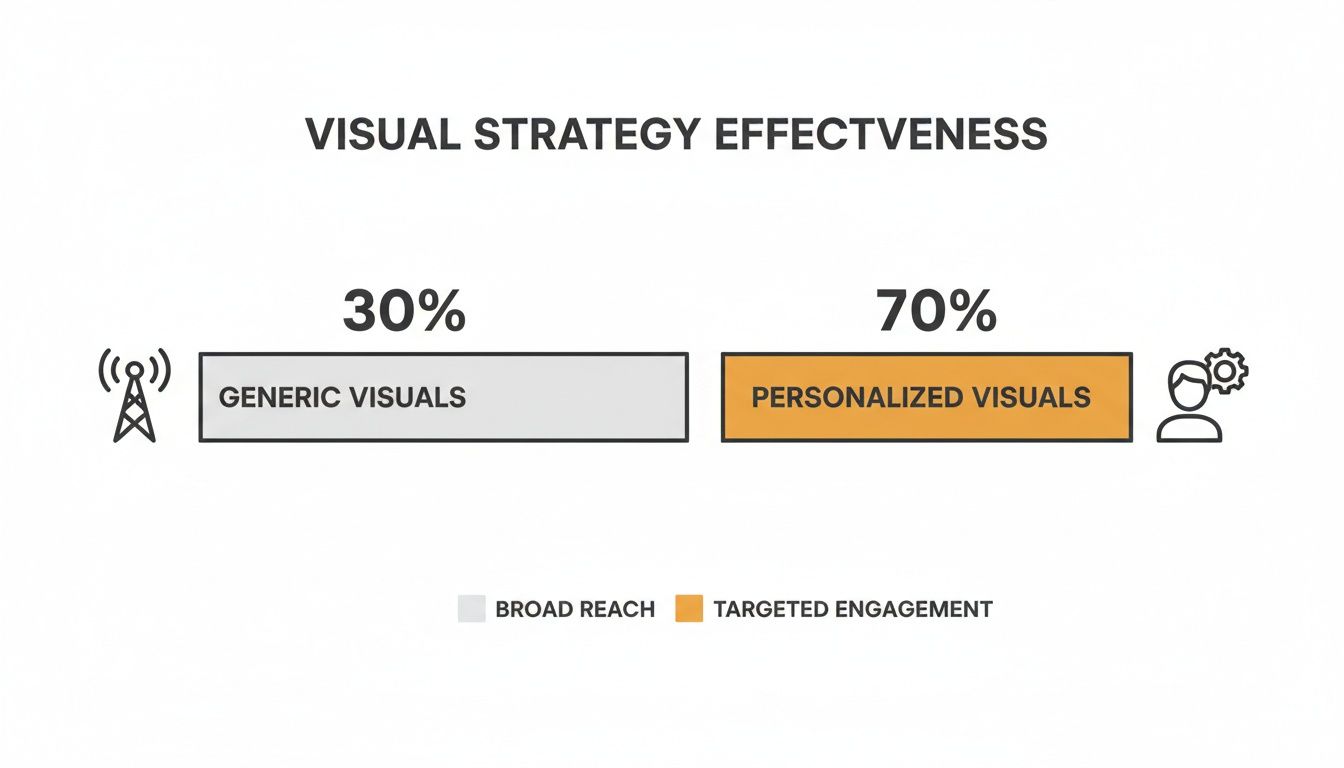
As you can see, while generic visuals still have a place for broad-reach campaigns, personalized visuals are the clear winner for driving targeted engagement.
Driving Engagement and Conversions
Personalized visuals create a powerful psychological link. When a customer sees their name, their company, or other relevant details woven seamlessly into an image, it validates their importance to your brand. That feeling of being seen is a powerful trigger for taking action.
Studies consistently show this heightened relevance leads directly to better performance across your marketing channels. Email marketing, in particular, shows just how dramatic the lift can be. By simply segmenting audiences and tailoring content, businesses can achieve incredible results.
In one powerful example, a company that used preference-based segmentation for its email newsletters saw a 117% jump in open rates and an 82% increase in click-through rates compared to its generic campaigns. Even better, this surge in engagement led to a 170% year-on-year revenue increase, proving the direct line between personalization and profit. You can dig deeper into these kinds of impressive marketing personalization statistics and their impact.
Building Lasting Customer Loyalty
Loyalty isn't built on transactions; it's built on relationships. Personalized marketing visuals are one of the best tools for nurturing these connections at scale. Each tailored image reinforces the idea that you actually understand your customer's unique situation.
Personalization is more than a tactic—it's a retention strategy. By consistently delivering relevant visual experiences, you make customers feel valued, reducing churn and increasing their lifetime value.
This approach turns your marketing from a series of disconnected campaigns into a continuous, personal conversation. Think about the long-term impact of making every customer feel like a VIP.
- Increased Stickiness: Customers who feel understood are far less likely to jump ship to a competitor.
- Higher Lifetime Value: Loyal customers not only spend more over time, but they also become your best advocates.
- Positive Brand Perception: Consistent personalization builds a reputation for being customer-centric and genuinely attentive.
Quantifying the Return on Investment
Perhaps the most compelling argument for personalized visuals is the clear, measurable return on investment (ROI). Unlike some branding efforts that can feel a bit fuzzy to quantify, the impact of personalization can be tracked with precision. The lift you see in key performance indicators (KPIs) is often immediate and substantial.
To really grasp the financial benefits, let's look at a direct comparison of how generic and personalized visuals perform on key metrics.
Generic vs Personalized Visuals Impact on Key Metrics
Here's a look at the performance lift businesses often see when they switch from standard, one-size-fits-all visuals to personalized ones.
| Marketing Metric | Performance with Generic Visuals | Performance with Personalized Visuals | Potential Uplift |
|---|---|---|---|
| Email Click-Through Rate | Standard industry average (2-5%) | Often doubles or even triples | 100-200%+ |
| Landing Page Conversions | Baseline rates based on broad appeal | Higher conversions due to relevance | 20-50%+ |
| Social Media Engagement | Standard likes, comments, and shares | Boosted interaction from tailored content | 50-100%+ |
| Customer Retention | Average churn rates for the industry | Lower churn from stronger connections | 5-15% reduction |
This data shows that investing in a tool like OKZest to automate your visual personalization isn't just about adding creative flair. You're putting a proven system in place to boost engagement, build loyalty, and drive real revenue. The business case is undeniable: in today's market, personalization isn't a luxury—it's essential for growth.
Powerful Use Cases Across Different Industries
This is where the rubber meets the road. It's one thing to talk about personalized visuals in theory, but seeing them in action is what really makes the concept click. The applications are incredibly versatile, cutting across dozens of industries and channels, from email to social media DMs.
Let's dive into a few real-world examples of how smart professionals are using this strategy to create memorable moments that get real results. These aren't just hypotheticals; they're practical mini-stories that show how a little personal touch can make a huge impact.
Tools like OKZest are built to generate countless unique visuals just like these, all automatically.

The image above shows just a few ways you can create a one-to-one visual experience, moving far beyond generic stock photos.
For Event Marketers and Organizers
Event marketers are always juggling a million moving parts, and making attendees feel special from the start is a constant challenge. Instead of a generic confirmation email with a bland PDF attachment, imagine creating an experience that feels professional and exciting.
Picture sending a digital event ticket where each attendee’s full name is beautifully woven into the design. It's a small detail, but it instantly makes the ticket feel more like a special invitation and less like a simple proof of purchase. This elevates the entire pre-event experience and can even make check-in smoother.
- How it works: The event marketer designs a single ticket template. Then, using a list of attendee names, their system automatically generates a unique, personalized ticket image for every single person.
- The channel: These personalized marketing visuals are perfect for confirmation emails, pre-event reminders, or even direct messages on social media.
For Real Estate Agents
The real estate market is fiercely competitive, and building a personal connection can make all the difference. Agents can use personalized visuals to stand out and make a killer first impression long before an actual viewing.
A simple but powerful tactic is to create a property photo with a prospect's name on a "Welcome Home" sign, digitally placed right by the front door. When a potential buyer gets an email with an image that already pictures them in the space, it creates an immediate emotional connection to the property. It’s a small gesture that shows the agent is thoughtful and attentive.
This strategy transforms a standard property listing into a personal invitation. It helps potential buyers visualize their future and solidifies the agent's role as a thoughtful guide in their home-buying journey.
An approach like this is far more compelling than a generic email blast and can seriously boost response rates and viewing requests.
For Online Coaches and Consultants
Coaches and consultants build their businesses on celebrating their clients' wins. After a client finishes a course, a workshop, or a coaching program, a personalized certificate of completion is a fantastic way to recognize their hard work.
Instead of a generic, downloadable template, a coach can automatically generate a high-quality certificate featuring the graduate's name and the completion date. This professional touch not only validates the client's effort but also creates a shareable asset. Graduates are often proud to post their certificates on platforms like LinkedIn, giving the coach valuable social proof and organic marketing.
This shows how personalized marketing visuals can go beyond just sales and lead gen to help foster a strong community and spark word-of-mouth referrals.
These use cases are just scratching the surface. Think of a nonprofit sending personalized thank-you graphics to donors or a sales team creating custom proposals with a prospect's company logo—the possibilities are endless. Each example proves the same point: when you speak to individuals instead of masses, you build stronger connections and get better results.
How to Implement Personalized Visuals
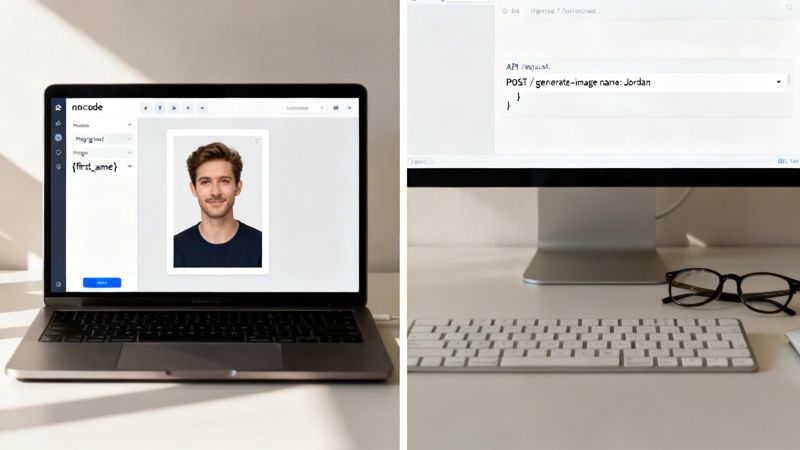
Putting personalized visuals into practice might sound like a heavy technical lift, but it’s more accessible than you think. Modern tools have opened up two clear paths: one for marketers who want to move fast without code, and another for developers who need deep, custom integration.
The goal is to make this powerful strategy available to everyone, whether you're a one-person shop or part of a large enterprise. It really boils down to two options: a user-friendly, no-code platform or a flexible API. Each has its own strengths, depending on your team's skills and what you'm trying to achieve.
The No-Code Path for Marketers
For most marketers, the no-code approach is the quickest way to get a campaign out the door. It's designed for simplicity, letting you create and embed personalized visuals without touching a single line of code. Think of it as a drag-and-drop editor, but for dynamic images.
Platforms like OKZest are perfect for this. You get a visual editor to design a master template for your image. From there, you can add text layers, images, or other elements that will change for each person you send it to. The whole process feels a lot like using merge tags in your email campaigns, which you probably already do.
Here’s a look at the typical no-code workflow:
- Design Your Template: Start by creating a base image. This might be a certificate, an event ticket, or a simple promo graphic. Then, you decide which parts should be dynamic—like a name, a company logo, or a unique QR code.
- Connect Your Data: You link these dynamic layers to your data fields, just like you would with
{{FirstName}}in an email. This tells the system where to pull the info from. - Generate a Merge Tag URL: The platform then generates a unique URL. This isn't a static link; it's a smart URL that has your merge tags built right in.
- Paste and Send: Just copy that URL and paste it into your email service provider (ESP) like Mailchimp, Instantly, or Klaviyo. When you hit send, your ESP fills in the merge tags, and the platform generates a unique image for every single recipient on the fly.
This seamless integration means you can slot highly personalized visuals into your existing workflows in minutes. It’s built for marketers who want to focus on strategy, not wrestle with technical setups.
The API Path for Developers
For developers or businesses that need more control and deeper integration, an API-driven solution offers incredible power. This path lets you programmatically generate thousands or even millions of personalized marketing visuals in real-time, right inside your website, app, or custom software.
An image generation API works by taking instructions via a simple request and returning a finished, personalized image. This is perfect for scenarios where personalization needs to happen instantly based on a user's actions.
An API approach decouples image creation from any single marketing platform, turning your entire technology stack into a personalization engine. It empowers you to embed dynamic visuals anywhere you can write code.
Here are a few places where an API is the ideal fit:
- SaaS Platforms: Automatically generate personalized welcome images for new users right inside the app's dashboard.
- eCommerce Sites: Create dynamic images showing a customer's name on a product they’re looking at.
- Large-Scale Campaigns: Generate unique visuals for millions of users in a mobile app push notification campaign.
For a developer, the process is straightforward. They make an API call specifying the base template and the dynamic data for a user. The API returns a URL to the newly created image, which can then be embedded anywhere.
To make these visuals even more compelling, especially at scale, learning how to generate AI video from text can be a game-changer for content teams, opening up possibilities beyond static images. Whether you choose the simplicity of no-code or the power of an API, the tools are ready to bring your vision for personalized marketing to life.
Best Practices for Effective Campaigns
Creating powerful personalized marketing visuals is one part technology, one part strategy. Just having the tool isn’t enough—real success comes from using it thoughtfully. If you follow a few key best practices, your campaigns won't just look great, they'll perform brilliantly and deliver a flawless experience every time.
These guidelines will help you move beyond simply swapping out names and start creating truly effective, data-driven visual campaigns that connect with your audience and drive measurable results.
Start with Clean and Organized Data
The engine behind any great personalization effort is your data. If it’s messy, incomplete, or inaccurate, your personalized images will be, too. A visual that says "Hello, {{FirstName}}!" isn't very impressive when that field is blank, turning your clever campaign into a technical error.
Before launching anything, take the time to clean up your contact list. Make sure essential fields like names, company names, or other data points you plan to use are properly formatted and filled out. This simple step is the foundation of a professional-looking campaign.
Think of your customer data as the fuel for your personalization engine. Clean, high-octane fuel will give you a smooth, powerful performance, while dirty fuel will cause sputtering and breakdowns.
A little preventative maintenance here ensures every visual you generate is accurate, relevant, and makes the impact you intended.
Always Have a Fallback Plan
What happens when data is missing? This is one of the most common—and easily avoidable—pitfalls in personalization. Without a plan, a missing first name could result in a broken or awkward-looking image, which immediately damages your brand's credibility. This is where fallback images come into play.
A fallback is a default value or image that your system displays when a specific piece of data isn't available. For example:
- For Text: If a
{{FirstName}}tag is empty, your fallback could be a more generic greeting like "Valued Customer" or "Friend." - For Images: If you're personalizing with a company logo and it's missing, you could show your own logo or a default industry icon instead.
Setting up fallbacks in a platform like OKZest is crucial. It’s a safety net, guaranteeing that every single person on your list receives a complete, professional visual, no matter how complete their contact record is.
Design with Dynamic Content in Mind
Designing a template for personalized visuals requires a different mindset than creating a static graphic. You have to account for variability. A name like "Jen" takes up far less space than "Christopher," and your design needs to accommodate both gracefully without looking cramped or empty.
Here are a few design principles to keep in mind:
- Use Generous Spacing: Leave plenty of white space around dynamic text fields to handle names and other text of varying lengths.
- Choose Legible Fonts: Select fonts that are clear and easy to read at different sizes. Test them with both long and short words to be sure.
- Center-Align Text: When in doubt, center-aligning dynamic text is often the safest bet. It helps maintain visual balance regardless of how long the text is.
- Consider Image Ratios: If you're swapping out logos or user photos, ensure your template works well with both square and rectangular images.
Thinking ahead about these variations during the design phase will save you countless headaches later and ensure your visuals always look polished. For more technical details on how this works behind the scenes, you might be interested in our guide on using an API for personalized graphics.
Measure What Matters
Finally, a successful campaign is one you can measure and learn from. To understand the true impact of your personalized visuals, you need to track the right key performance indicators (KPIs). Move beyond standard email open rates and focus on metrics that show a direct link between the visual and what a user does next.
Key metrics to monitor include:
- Image Click-Through Rate (CTR): Are people clicking on the personalized image itself? This is a strong signal of engagement.
- Conversion Rate Lift: Compare the conversion rate of a campaign using personalized visuals against a control group with static images.
- Social Shares: If you're using visuals like personalized certificates, track how often they are shared on social media.
Tracking these specific KPIs will give you clear, actionable data on what’s working, helping you refine your strategy and prove the ROI of your efforts.
The Future of AI and Visual Personalization
The world of personalized marketing is gearing up for its next big leap, and it's all being driven by the powerful duo of Artificial Intelligence and dynamic visuals. We're quickly moving past the simple trick of dropping a customer's name onto an image. The future is hyper-personalization, where AI actually predicts and builds the perfect visual experience for each person, right on the spot.
Think about an AI that doesn't just know a customer's name but also gets their vibe. It could analyze past behavior to decide if a bright, punchy color scheme will work better than a calm, minimalist one for a specific individual. This is where personalized marketing visuals are headed—a proactive, predictive way of having a one-on-one conversation.
The Rise of Predictive Visuals
The big idea here is shifting from reactive to predictive personalization. Instead of just using the data you already have, AI will start forecasting which visual ingredients are most likely to get a specific person to take action. It’s like having a master marketer dedicated to every single customer, making creative calls at a scale no human team ever could.
This means AI could soon handle things like:
- Predicting Optimal Imagery: Automatically picking a product photo that lines up with a user's browsing history or even the weather in their city.
- Tailoring Calls to Action: Dynamically tweaking the text, color, and even placement of a CTA button based on what’s most likely to convert that person.
- Adapting Brand Tone: Shifting the entire mood of an image—from playful to professional—to match what you know about a customer's preferences.
This kind of intelligence turns a personalized image from a neat gimmick into a seriously strategic marketing asset.
The real power of AI in visual personalization isn't just knowing who the customer is, but predicting what they'll respond to next. It turns every visual into a data-backed experiment designed to maximize impact.
Future-Proofing Your Marketing Strategy
Jumping on these advanced personalization technologies is quickly becoming a strategic need, not just a cool trend for the future. The growth in this space is absolutely explosive, signaling a massive industry-wide shift. For example, the AI-enabled eCommerce market, which was valued at $9.01 billion in 2025, is expected to skyrocket to $41.42 billion by 2032. That's a staggering 359% increase, highlighting just how fast AI-driven personalization is being adopted. The ROI is just as convincing, with AI-led personalization boosting retail profits by up to 15% while cutting marketing costs by nearly 20%. You can dig into more of these personalization trends and their financial impact.
Getting comfortable with today's personalization tools is the perfect warm-up for the AI-driven future. If you master the fundamentals of data management, template design, and fallback strategies now, you’ll be ready for the more powerful systems just around the corner. By bringing a platform like OKZest into your workflow today, you aren't just making your current campaigns better; you're building the skills and the mindset you'll need to win in the next era of marketing.
If you're interested in how all this fits together, you can learn more about artificial intelligence and personalization in our detailed article.
A Few Common Questions About Personalized Visuals
As you start thinking about bringing this strategy into your own marketing, a few questions usually pop up. Let's get them answered so you can move forward with a clear plan.
Here are the most common things we get asked about implementing personalized marketing visuals.
Is This Going to Be Expensive?
Not at all. While a fully custom-coded solution might have been a big investment in the past, today's platforms have made this technology easy and affordable for just about any business. The focus now is on scalability and a solid return on your investment.
Many tools, including OKZest, have pricing tiers that start with a free plan. This lets you get your feet wet and prove the value of personalization before you ever have to commit to a budget. Honestly, the boost you see in engagement and conversions almost always makes the investment a no-brainer.
The real cost isn’t in trying personalization—it’s in sticking with generic visuals that your audience has learned to ignore. The lift in performance from a personalized campaign quickly covers the modest expense.
Will Personalized Images Work With My Email Platform?
Yep. Compatibility is a huge part of what makes modern personalization tools work so well. These platforms are built from the ground up to integrate smoothly with the email service providers (ESPs) and marketing automation systems you're already using.
It's usually as simple as using a special link called a merge tag URL. You just copy and paste this link into your email editor, the same way you would for a text merge tag like {{FirstName}}. Platforms like OKZest are compatible with over 99% of ESPs, including all the big ones like Mailchimp, Klaviyo, and Instantly.
What Happens If I'm Missing Some Customer Data?
This is a great question, and it's handled by a simple but powerful feature called a "fallback." A fallback is just a default image or piece of text that shows up automatically when a specific bit of data is missing for a contact.
For example, if you don't have a first name for someone, the visual can display a friendly default greeting like "Hello there!" instead of a blank space. This ensures every single person sees a complete, professional-looking image. You never have to worry about sending out a broken or empty graphic.
Ready to create stunning personalized marketing visuals that actually get noticed and drive action? With OKZest, you can automate the whole process with our no-code editor or our powerful API. Start for free on okzest.com and see what a difference a personal touch can make.