Let’s get one thing straight: enterprise email personalization isn't about dropping a [First_Name] merge tag into a generic subject line and calling it a day. That's old-school thinking.
True enterprise-level personalization is about creating a unique, one-on-one conversation with every single customer, scaled to millions.
Think of it like this: a generic email is a billboard on the highway. Everyone sees the same message, whether they’re driving a sports car or a minivan. Enterprise personalization, on the other hand, is a dedicated personal shopper who knows your style, your purchase history, and what you were just browsing online five minutes ago.
This isn't just a "nice-to-have" feature anymore; it's a core business driver that customers have come to expect. The whole strategy is built on a mountain of data—transactional records, real-time behavioral signals, and rich demographic profiles—to deliver content that actually resonates. We're talking tailored offers, custom product recommendations, and even dynamic, personalized images that change for each individual.
Moving From Mass Messaging to Individual Conversations
The gap between standard personalization and an enterprise approach is massive. Standard methods usually stop at segmentation, which is just lumping customers into broad buckets. An enterprise strategy drills all the way down to the individual. You can learn more about the broader concept of personalization in marketing in our detailed guide.
At the enterprise level, the goal is to make a million-person email send feel like a million individual conversations. It’s about using data to prove you understand each customer's unique journey and needs.
The numbers don't lie. This shift is a huge competitive advantage. Research shows that campaigns using even basic segmentation can generate up to 760% more revenue. But when you get to true 1:1 personalization, emails deliver 6x higher transaction rates. Even more telling? A stunning 58% of all email revenue now comes from these advanced, tailored campaigns.
Here's a quick comparison to show just how far things have come.
Standard vs Enterprise Personalization
| Feature | Standard Personalization | Enterprise Personalization |
|---|---|---|
| Data Source | Basic CRM data (name, location) | Integrated data from CRM, CDP, web analytics, purchase history, and real-time behavior |
| Approach | Audience segmentation (e.g., "new customers") | 1:1 individualized content |
| Content | Static text with merge tags | Dynamic content blocks, personalized product recommendations, and unique image merge tags |
| Timing | Scheduled batch sends | Triggered by real-time user behavior (e.g., cart abandonment) |
| Scale | Thousands | Millions, with unique experiences for each |
| Goal | Increase open rates | Drive revenue, loyalty, and lifetime value |
Ultimately, enterprise email personalization is about building the data, technology, and strategic foundation needed to make individual connections a reality at an immense scale. It’s a completely different ballgame.
Building Your Data and Technology Foundation
Great email personalization doesn't just happen. It's built on a carefully designed architectural blueprint. Think of it like a skyscraper—without a deep, solid foundation, it doesn't matter how impressive the design is; it will eventually crumble. Your personalization strategy is the same. It needs a robust data and technology layer to support its complexity and scale.
The whole operation begins with the heart of your marketing technology: your data. Most enterprise companies are wrestling with customer data that's scattered all over the place. You've got a CRM over here, an e-commerce platform over there, and analytics tools somewhere else entirely. This fragmentation makes getting a single, clear view of your customer practically impossible.
Unifying Your Customer Data
The first, most critical step is to tear down those data silos. The most successful organizations do this by establishing a single source of truth, usually with a Customer Data Platform (CDP). A CDP is designed to pull in information from all those disconnected sources, clean it up, and stitch it all together into one complete profile for each customer.
This is the process that turns a messy, fragmented pile of information into clean, actionable intelligence. And "clean data" isn't just about making sure things are formatted correctly. It means your data is:
- Accurate: The information you have on your customers is correct and current.
- Unified: Data from different systems is all linked back to the right person.
- Accessible: Your marketing platforms can grab the data they need in real-time.
That real-time element is non-negotiable for enterprise personalization. To deliver a timely, relevant experience, you need to know what a customer did seconds ago, not last week. If someone abandons their cart, that signal has to be available instantly to trigger a follow-up email.
This diagram shows how personalization matures, moving from generic mass emails to highly specific, individual conversations.
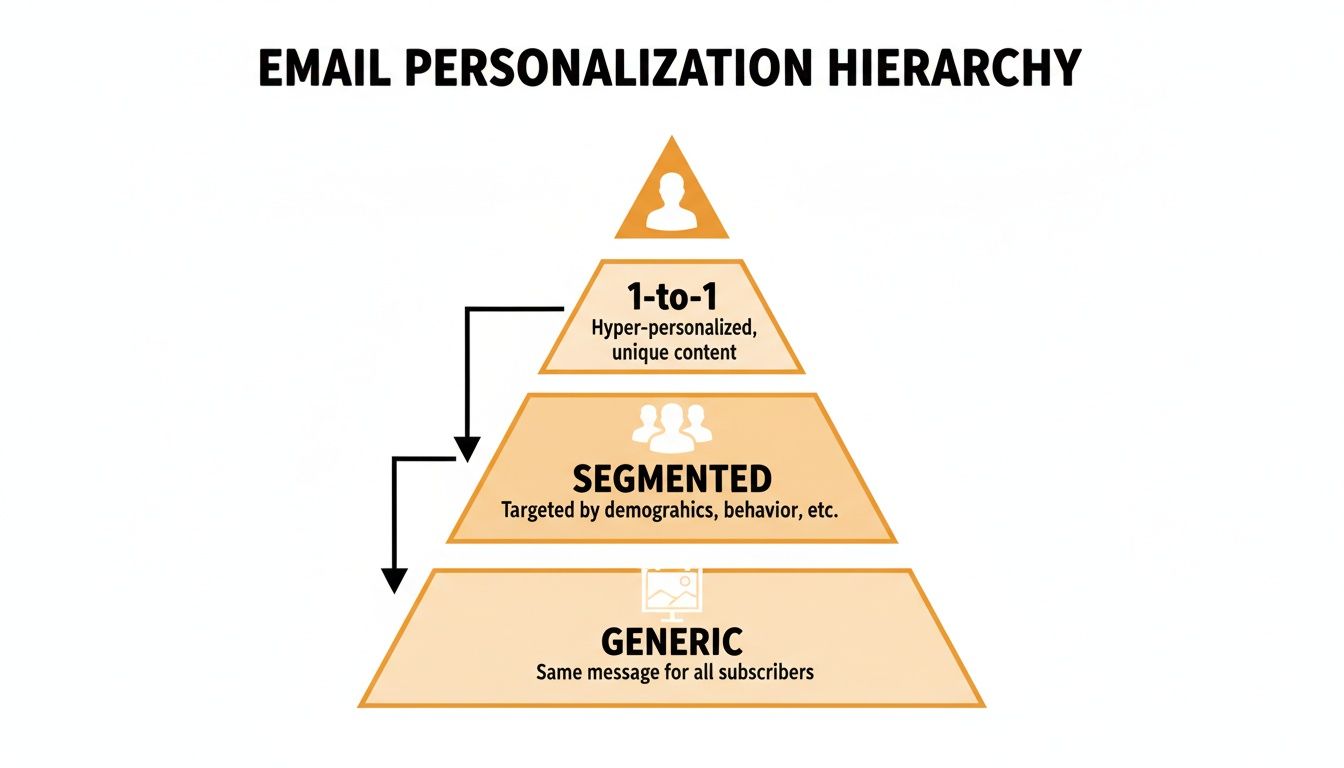
The pyramid shows the journey from shouting the same message to everyone at the bottom, all the way up to creating unique 1-to-1 experiences at the peak—which is where you want to be.
Creating a Cohesive Technology Ecosystem
Once you have a unified data layer, the focus shifts to the technology that actually brings it to life. Your tech stack can't just be a random collection of tools. It has to work like a cohesive ecosystem, where information flows freely without hitting technical roadblocks.
The goal is to create a seamless integration loop: data informs the personalization engine, the engine executes the campaign through your ESP, and the results feed back into the data layer to refine future interactions.
This ecosystem usually involves a few key players working together:
- Customer Data Platform (CDP): This is your central hub. It collects and unifies all customer data to build those 360-degree profiles.
- Email Service Provider (ESP): This is the delivery engine that sends the emails. It absolutely must be able to pull in and act on the rich data from your CDP.
- Automation Platform: This component handles the logic and triggers for your campaigns, making sure messages are sent at the perfect moment based on what a user does.
- Specialized Personalization Tools: These are essential for more advanced tactics. For instance, a tool like OKZest can integrate with your stack to deliver dynamic, personalized images at scale, acting almost like a merge tag for visuals.
When these systems are properly connected, you can run sophisticated strategies that would otherwise be out of reach. This integration allows your ESP to pull a customer's recent browsing history from the CDP, use that data to populate dynamic content blocks in an email, and then call a tool like OKZest to generate a unique hero image featuring the exact products they just looked at.
This level of technical harmony is the true foundation of enterprise-grade personalization. As you start refining your data inputs, you might also want to learn more about the strategic value of zero-party data in our guide to make your customer profiles even richer.
Advanced Personalization Strategies That Drive Engagement
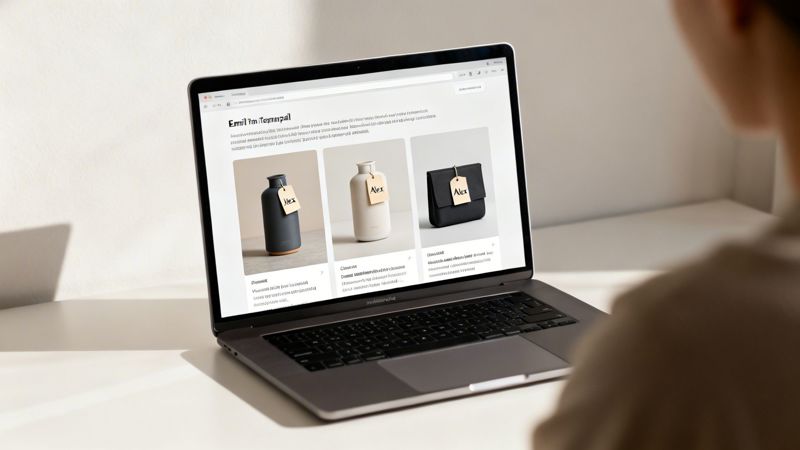
With your data foundation and tech stack sorted, it's time to put it all into action. This is where the real magic happens—where leading brands pull away from the competition by using tactics that leave basic segmentation in the dust. These strategies turn a standard email into a dynamic, one-to-one conversation that feels like it was crafted just for that person.
The whole point is to make every email feel like it was designed for an audience of one. We're not just talking about dropping a first name into the subject line. We're talking about fundamentally changing the email's content based on everything you know about an individual. This is what grabs attention and gets people to act.
Dynamic Content Blocks
Think of an email as a set of LEGO bricks. With dynamic content, you can swap these bricks in and out for different people. A brand new customer might see a welcome offer and a "how to get started" guide, while a VIP customer sees a block with early access to a new product—all within the same campaign.
This method is incredibly efficient. Instead of building dozens of separate email campaigns, you create a single master template with variable sections. You set the rules, and the system does the rest, deciding which content block each person sees based on data like:
- Lifecycle Stage: Showing different calls-to-action for prospects, new customers, and loyal fans.
- Geographic Location: Displaying promotions for a local store or offers relevant to their city or season.
- Past Purchase Behavior: Highlighting product categories a customer has shown interest in before.
This approach makes sure every part of the email is as relevant as possible, which dramatically increases your chances of getting a click.
The core idea behind dynamic content is simple yet profound: no pixel should be wasted. Every section of an email is an opportunity to deliver a more relevant, compelling message based on individual customer data.
Predictive Personalization With AI
The next level is using Artificial Intelligence (AI) to guess what your customers want before they even know they want it. AI algorithms crunch huge amounts of data—browsing history, purchase patterns, even social media interactions—to predict what a customer is likely to be interested in next. This is where enterprise email personalization becomes truly proactive.
Predictive personalization can power a few key things:
- Product Recommendations: Instead of showing generic "bestsellers," AI can suggest products that a specific person is statistically most likely to buy.
- Churn Prediction: AI models can flag customers who are about to leave, letting you automatically send a re-engagement campaign with a special offer to win them back.
- Optimal Send Times: The system learns when an individual usually opens their emails and schedules your message to land at that perfect moment.
The results speak for themselves. One beauty brand boosted its click-through rates by 50% and revenue by 40% simply by using AI to decide which message to send next based on a customer's last action.
To get a clearer picture of what these strategies can do, let's look at the numbers. The right tactic can have a significant impact on your core metrics.
Impact of Advanced Personalization Tactics
| Personalization Tactic | Primary Goal | Typical Metric Uplift (CTR, Conversion) |
|---|---|---|
| Dynamic Content Blocks | Boost relevance for broad segments | 15-25% increase in CTR |
| AI-Powered Recommendations | Increase Average Order Value (AOV) | 20-35% lift in conversion rates |
| Behavioral Triggers (e.g., Abandoned Cart) | Recover lost revenue | 10-30% conversion uplift |
| Personalized Send Times | Improve open and engagement rates | 5-15% higher open rates |
| Hyper-Personalized Visuals | Create "wow" moments and drive action | 30-60% increase in CTR |
As you can see, moving beyond basic name-merging unlocks serious potential. The more tailored the experience, the better the response. It's about meeting customers where they are with content that proves you're paying attention.
Hyper-Personalized Visuals With OKZest
Text personalization is great, but visual personalization is where you create a genuine "wow" moment. One-size-fits-all images are on their way out. Today, you can generate unique, dynamic images for every single person on your email list, completely automatically.
This is where a tool like OKZest completely changes the game. It works just like merge tags, but for your images. You design one image template and let it automatically fill in personalized details for each individual.
Just imagine these scenarios:
- An airline sends a flight reminder where the hero image is a boarding pass with the recipient's name and destination city already on it.
- A retail store sends a cart abandonment email showing a dynamic image of the exact product the customer left behind, maybe with their name artfully placed on the mockup.
- An event organizer sends a confirmation email with a personalized ticket image showing the attendee's name and a unique QR code.
This kind of visual touch makes your message feel incredibly personal and direct. It stops the scroll and grabs attention in a way that plain text just can't, creating a memorable experience that strengthens your brand and drives conversions.
Unlocking Growth with Automated and Personalized Workflows
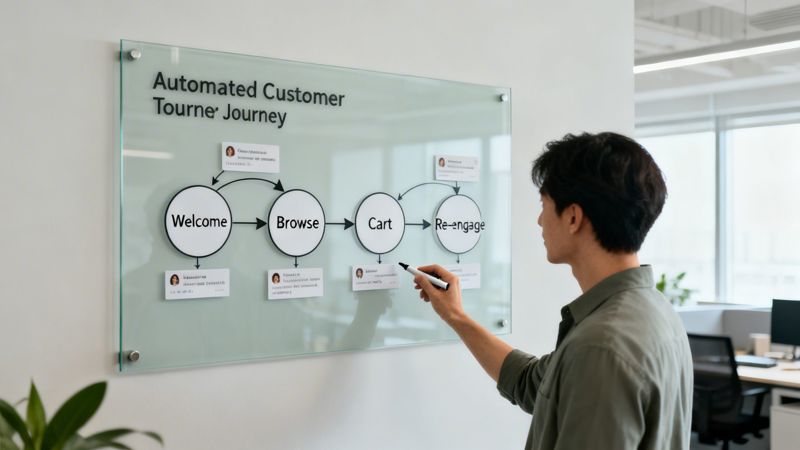
This is where enterprise email personalization really starts to cook. One-off personalized campaigns are a great start, but the real magic happens when you build automated, self-sustaining workflows that nurture customers 24/7. It’s how you create a growth engine that runs on its own, with very little hands-on effort once it's set up.
The trick is to see automation and personalization as two sides of the same coin. They work together perfectly.
- Automation is the brain behind the 'when'. It’s the logic that decides the timing and triggers for every message, making sure your emails land at just the right moment.
- Personalization is the heart behind the 'what'. It’s the intelligence that fills that email with the specific message, offer, or image that will resonate with each person.
When you bring them together, you create an experience that feels both incredibly timely and personally relevant. It’s the difference between sending a generic weekly newsletter and a perfectly timed email with a special offer for a product someone was just looking at.
Mapping Workflows to the Customer Journey
The best automated workflows aren’t just a random sequence of emails. They’re strategically mapped to key moments in the customer lifecycle. By injecting deep personalization at each stage, you can gently guide customers from their first visit all the way to becoming loyal fans.
Here are a few critical workflows where this combination really shines:
- Adaptive Welcome Series: Please, don't send the same three emails to every new subscriber. A personalized welcome series can change course based on how someone signed up. Did they subscribe through a blog post about running shoes? The workflow should immediately start showing them content and offers related to running.
- Behavior-Triggered Nurturing: If a customer keeps looking at the same jacket but doesn't buy it, an automated workflow can send a follow-up. That email can feature the exact item, maybe with some customer reviews or a dynamic image showing it in different colors, to give them that final nudge.
- Intelligent Re-engagement Campaigns: When a customer goes quiet, a generic "we miss you" email is background noise. A personalized re-engagement workflow, on the other hand, can showcase products related to their past purchases or highlight new arrivals in their favorite categories. Now you've given them a real reason to come back.
At its core, this strategy is about using automation to listen for customer signals and using personalization to craft the perfect response. It ensures that every automated interaction adds value and strengthens the customer relationship.
The performance difference is astounding. While email automation is a powerful tool for any enterprise, it’s the results that tell the story. Automated emails generate conversion rates that are 4x better than other email types. A typical campaign might see a 1.29% click-through rate, but automated flows can hit 48.57% open rates and a 4.67% CTR. That’s just a world away from manual sends.
The Tools That Power Automated Personalization
To pull these kinds of workflows off, your tech stack needs to be buttoned up. Your CDP, ESP, and any specialized personalization tools have to talk to each other instantly to pass data and trigger actions in real-time. To really scale these efforts, looking into the best AI email assistants can be a game-changer for managing the complex logic needed for these deeply tailored journeys.
By building out these intelligent systems, you stop just sending campaigns and start designing customer experiences that run on their own. If you're looking to get into the nitty-gritty, you can explore our complete guide on how to build a marketing automation workflow for more detailed steps.
Measuring Success and Proving Your ROI
An ambitious enterprise email personalization strategy is a fantastic investment, but to keep that investment coming, you have to prove it’s actually working. Leadership isn't just wowed by impressive open rates; they need to see a straight line connecting your team's efforts to the company's bottom line.
This means we have to look beyond the surface-level vanity metrics. Proving the value of personalization requires shifting the focus from simple clicks to KPIs that scream business impact. These are the numbers that build a rock-solid case for your strategy and justify the resources you need.
KPIs That Matter to Leadership
When you walk into that review meeting, lead with the metrics that translate directly into dollars and cents. These are the three core KPIs that should be the bedrock of your reporting:
- Customer Lifetime Value (CLV): This is the ultimate report card. A great personalization program doesn't just sell one more product; it creates fiercely loyal customers who spend more over their entire relationship with you. Tracking CLV by segment clearly shows the long-term financial payoff of creating these tailored experiences.
- Revenue Per Recipient (RPR): This KPI cuts right through the noise. It ignores opens and clicks to show you exactly how much money each email is generating on a per-person basis. It’s a beautifully simple and powerful way to show the direct financial kick of any given campaign.
- Segment-Specific Conversion Rates: This is where the story gets interesting. Dive into how different customer groups respond to your personalized content. Showing that a high-value segment is converting at a 15% higher rate thanks to personalization is a powerful narrative that validates your entire data strategy.
Your goal is to change the conversation from, "Hey, lots of people opened our email," to, "This email generated X dollars in revenue from our most important customer segment." That’s the language that secures future investment.
Isolating Impact with Rigorous Testing
To say with 100% confidence that your personalization drove that revenue spike, you need a disciplined testing plan. This is how you prove it was your specific tactic—and not just a holiday shopping surge or some other market trend—that delivered the goods.
The key is establishing a clean baseline for comparison, and that means every single personalization test needs a control group. This group gets the generic, one-size-fits-all version of the email. Without that control, you're just guessing how much of a lift your personalization really created.
Let's say you're testing dynamic images with OKZest. You could set up a simple A/B test like this:
- Group A (Control): Gets the email with your standard, generic hero image.
- Group B (Personalized): Gets the email with a dynamic hero image from OKZest showing a product they just browsed.
By comparing the RPR and conversion rates between Group A and Group B, you can pinpoint the exact financial impact of adding that single personalized visual. A key part of demonstrating this is having solid measurement in place, including effective ROI tracking with email engagement metrics. This structured, data-first approach turns your assumptions into undeniable proof, making it a whole lot easier to justify your budget and expand your programs.
Common Pitfalls and How to Avoid Them
Rolling out a sophisticated enterprise email personalization strategy is a game-changer, but the path isn't always smooth. Let's be honest, it’s often littered with challenges. Navigating these hurdles is what separates a high-ROI program from a costly, ineffective one.
Knowing where others have stumbled is the best way to keep your footing.
The biggest tripwire, right from the start, is almost always data. Data silos are the classic culprit. Customer information gets trapped in different systems—the CRM, the e-commerce platform, the service desk—and they don’t talk to each other. This makes it impossible to get that single, unified view of the customer you need for real personalization, leading to emails that feel disconnected or, even worse, contradictory.
Then there's the "creepy" factor. It's a fine line between being helpful and being intrusive. Over-personalization, where a brand shows it knows a little too much, can seriously backfire. An email that brings up a product someone glanced at once, a month ago, often feels more like spying than good service.
Establishing Strong Governance and QA
When you have large teams working on personalization, the risk of small mistakes turning into big problems goes way up. A broken merge tag that blasts out Hello, [FNAME] to thousands of customers doesn't just look sloppy; it actively chips away at brand trust. Without solid governance, mistakes and inconsistency are pretty much guaranteed.
To get ahead of this, smart companies put a few key guardrails in place:
- Clear Roles and Responsibilities: Everyone needs to know who owns the data, who builds the campaigns, and who gives the final sign-off. This simple clarity prevents a ton of errors from slipping through the cracks.
- A Universal Style Guide: Create a central playbook for all dynamic content. It should cover everything from tone of voice and formatting rules to what the fallback option is when a piece of data is missing.
- A Rigorous QA Process: Every single personalized campaign needs to be tested across different scenarios. You have to check how it looks for a new customer versus a loyal one, or for someone with an incomplete profile.
The point of governance isn’t to slow things down. It’s to build a framework that empowers your teams to execute complex personalization with confidence. It’s what stops a small typo from becoming a major brand embarrassment.
Upholding Privacy and Building Trust
In today's world, data privacy isn't just a legal box to tick—it's a massive part of your brand's reputation. Navigating regulations like GDPR and CCPA is completely non-negotiable. This means having crystal-clear consent management and being totally transparent about how you're using customer data to shape their experience.
At the end of the day, it all comes down to trust. People are usually happy to share their data when they see a real benefit, like better offers or a smoother experience. But that trust is incredibly fragile. One privacy misstep or one creepy, over-the-top email can destroy years of loyalty in a heartbeat.
Ultimately, sidestepping these pitfalls is about balance. You need to combine powerful data and tech with thoughtful governance, a serious commitment to testing, and an unwavering respect for customer privacy. Get that foundation right, and you’ll build lasting customer relationships, not just a few extra clicks.
Frequently Asked Questions
When you start digging into enterprise email personalization, a few common questions always seem to pop up. It's easy to get bogged down by the details, whether it's the state of your data or the tech involved. Let's clear up some of the most frequent hurdles.
How Do I Start With Messy Data?
This is the big one. So many projects get stuck here because teams are waiting for the "perfect" dataset. My advice? Don't.
Waiting for flawless data is a recipe for going nowhere. Instead, just start small. Find a single, reliable data source you can trust—your e-commerce platform's purchase history is a fantastic starting point. Use that one source to run a pilot project with a clear win, like sending a post-purchase email featuring a dynamic image of the exact item someone just bought.
The goal is to get a quick win on the board. A successful pilot creates a powerful business case for a bigger data cleanup project, giving you the momentum and resources you need to scale up.
Are Personalized Images Too Complicated?
They definitely used to be, but modern tools have completely changed the game. Think of platforms like OKZest as "merge tags for images." All that old complexity that made personalized visuals impractical for enterprise use is gone.
You just design a single image template. The platform then takes over, automatically creating a unique version for every single person on your list by pulling their data straight from your ESP or CRM. This means you can scale visual personalization to millions of subscribers without a single minute of manual design work. It’s not just possible now; it's incredibly effective.
What Is the Real Difference Between Segmentation and Personalization?
Getting this distinction right is crucial. Segmentation is a one-to-few approach, while true personalization is always one-to-one.
- Segmentation: This is where you group your audience into big buckets based on shared traits (like 'recent buyers' or 'inactive users') and send them a message that fits the group.
- 1-to-1 Personalization: This goes deeper. It uses individual-level data to customize the content for each person inside that segment.
Imagine a segment of people get an email about a shoe sale. That's segmentation. True 1-to-1 personalization takes that same email and makes sure the main image shows the exact pair of shoes that specific individual was looking at yesterday. The difference in impact is massive.
Ready to create those "wow" moments and drive real engagement with visuals that speak to every customer individually? OKZest makes it simple to automate hyper-personalized images for your email campaigns. See how our no-code and API solutions can transform your strategy at https://okzest.com.