You've probably seen merge tags used in emails—those little placeholders like {{FirstName}} that get replaced with a subscriber's actual name. Now, imagine taking that same concept and applying it to images. That’s exactly what a personalized image API does.
It’s a clever piece of technology that creates unique images for every single person on your list by slotting their data—names, company logos, loyalty points, you name it—directly into a master image template. It's essentially merge tags for visuals, turning a generic marketing campaign into thousands of one-on-one visual conversations.
What Is a Personalized Image API
Think about the last email you got that truly caught your eye. What if, instead of a generic stock photo, it featured a concert ticket with your name perfectly styled on it? Or a coffee cup with your company’s logo on the side? That’s the kind of magic a personalized image API can deliver.
It goes way beyond just adding a name to a subject line. This is about embedding unique, personal data right into the graphics themselves.
At its heart, an API (Application Programming Interface) is just a bridge. It connects your data—whether it’s in a big CRM or a simple spreadsheet of subscribers—with an image template you’ve designed. When triggered, the API grabs a specific piece of data, like a user's name or a unique coupon code, and generates a brand-new, customized image in an instant.
From Static to Dynamic Visuals
This simple process transforms one static design into a limitless supply of unique visuals. Instead of a single image meant for everyone, you get a tailored image for everyone. This unlocks a level of personal connection that standard, one-size-fits-all graphics just can't touch.
The core idea is simple but powerful: transform mass communication into a series of personal, one-to-one visual experiences. This shift makes your audience feel seen and valued, which is critical for building lasting customer relationships.
The Technology Behind the Magic
The API does all the heavy lifting behind the scenes. It takes parameters you feed it through a URL—something like ?name=Jane&points=500—and renders an image that reflects that exact information.
This automation means you can scale your personalized outreach without breaking a sweat, whether you’re sending an email campaign to thousands of people or showing a unique welcome banner to a single new visitor on your website. This technology is a cornerstone of modern marketing, turning abstract data into something tangible and compelling. To dig a little deeper, you can learn more about how an image templating API automates visual creation in our detailed guide.
Why Dynamic Images Are a Marketing Game Changer
In a world of overflowing inboxes and endless social media feeds, generic visuals just don't cut it anymore. They're easy to scroll past and even easier to forget. Personalized images, on the other hand, grab your attention by creating an instant, one-to-one connection. They turn mass communication from a stale broadcast into a genuine conversation, making each customer feel seen and valued.
This small shift has a huge impact on the marketing metrics that matter. When a customer sees an image with their name, company logo, or maybe their loyalty points balance displayed right on it, they stop and look. That moment of personal recognition is incredibly powerful and drives far more engagement than any stock photo ever could.
The process behind it is surprisingly straightforward. A personalized image API simply takes your data and merges it with an image template to create a unique visual for every single person.
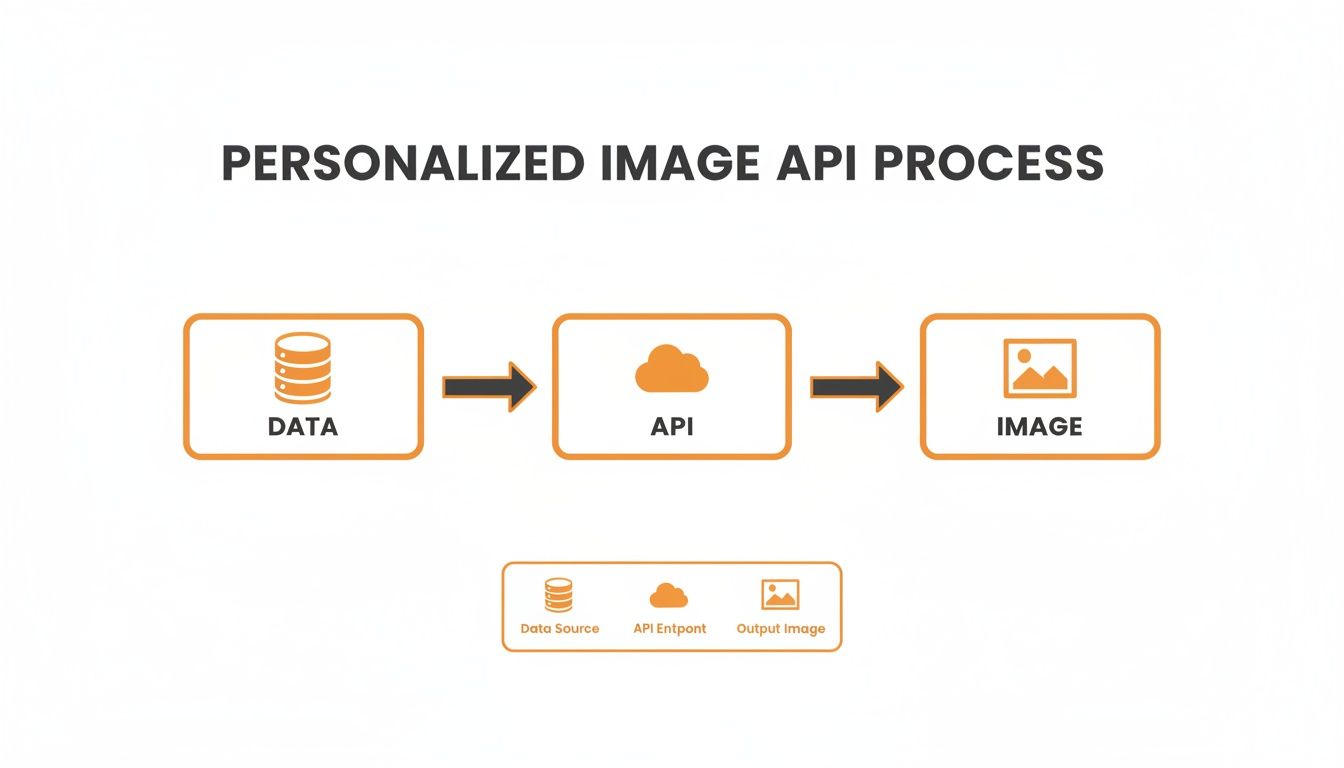
As you can see, the API acts as the engine, seamlessly connecting your data sources with a base image to generate a completely tailored visual on the fly.
Boosting Engagement and Conversions
This isn't just about getting a few extra likes or clicks; it's the first step toward building real customer loyalty and driving higher conversion rates. The numbers back this up. The AI Image Generator Market was valued at USD 3.16 billion in 2023 and is on track to hit a staggering USD 30.02 billion by 2033. This explosive growth is happening because businesses are seeing real results, with some firms reporting 25% better metrics after switching to personalized visuals.
Here’s a quick look at the kind of performance uplift we’re talking about.
Personalized vs Static Images A Performance Snapshot
This comparison highlights the typical performance uplift seen when marketers adopt dynamically personalized images over static, one-size-fits-all visuals in their campaigns.
| Metric | Static Image Campaign | Personalized Image Campaign | Potential Uplift |
|---|---|---|---|
| Email Open Rate | 18% | 29% | +61% |
| Click-Through Rate (CTR) | 2.5% | 7.5% | +200% |
| Conversion Rate | 1.2% | 4.2% | +250% |
The data is clear: personalization works. It moves the needle on the metrics that directly contribute to revenue and growth.
A personalized visual tells a customer, "We know you," while a generic image says, "We know people like you." That small distinction is the difference between being memorable and being ignored.
Think about a marketing team that used to send a standard email blast with a static "20% Off" banner. The results were okay, but nothing special. By using a dynamic image API, they started sending banners that said, "Here's 20% Off, Sarah!" This tiny change made their message feel exclusive and personal, leading to a huge jump in both click-throughs and sales.
From Ignorable to Unforgettable
This is the real magic of a personalized image API—it turns your brand from ignorable to unforgettable. It's a cornerstone of modern, data-driven content marketing, where you use what you know about your customers to create content that actually resonates. By creating these personal touchpoints, you're not just improving your campaign numbers for the month; you're building a stronger, more profitable brand for the long haul.
Powerful Use Cases Across Industries
A personalized image API isn't just a niche tool; it's a flexible powerhouse that can slot into just about any marketing or communication plan you can dream up. By turning raw data into compelling, custom visuals, businesses are creating those small, memorable moments that actually get people to act. From e-commerce to event management, the applications are as diverse as they are effective.
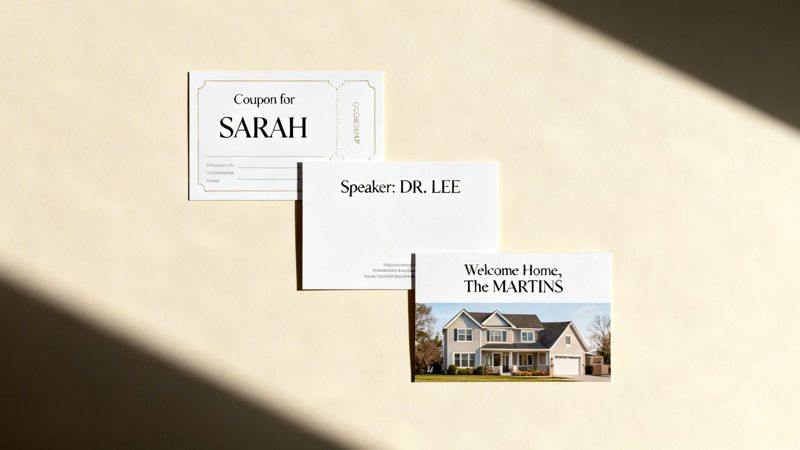
Think about an email marketer at an online clothing store. Instead of blasting out a generic "20% Off" banner, they use an API to send each customer a dynamic coupon with their first name beautifully designed right into the graphic. That simple touch makes the offer feel exclusive and personal, which can dramatically boost redemption rates.
This is all part of a bigger shift toward smarter, automated marketing. The global AI API market is expected to explode from USD 48.50 billion in 2024 to USD 246.87 billion by 2030. A huge piece of that growth comes from retail and e-commerce, where personalized ads are essential for making the shopping experience better and keeping customers engaged. You can learn more about the growth of the AI API market and its impact on retail from market analysts.
Driving Engagement and Amplifying Reach
But the power of a personalized image API goes way beyond email coupons. Imagine an event organizer managing a huge conference. Manually creating social media shout-outs for every single speaker is a time-consuming nightmare. With an API, they can instantly generate a unique "Featured Speaker" graphic for each person, automatically pulling in their headshot, name, and session title.
This automated process doesn't just save hundreds of hours; it empowers speakers to share professional, branded content with their own networks. Suddenly, a logistical headache becomes a powerful marketing multiplier, amplifying the event's reach across dozens of social platforms.
A personalized visual acts as a pattern interrupt. In a sea of generic content, an image that speaks directly to an individual—by name, by interest, or by association—is almost impossible to ignore.
From Sales Proposals to Donor Recognition
The applications are incredibly versatile, touching all sorts of business functions. A sales team, for instance, can make a killer first impression by embedding a prospect's company logo directly onto the cover of a digital proposal. It's a subtle touch, but it shows attention to detail and immediately frames the conversation around the client's brand.
Let's look at a few more industry-specific examples:
- Coaching and Consulting: A fitness coach uses a personalized image API to automatically generate weekly progress charts for clients, visualizing their achievements to keep them motivated.
- Real Estate: Agents send new homeowners a beautiful "Welcome Home" image featuring a picture of their house and their family name, creating a shareable moment they'll remember.
- Nonprofits: Organizations can send personalized thank-you images to donors, showing the direct impact of their contribution with their name featured prominently. This fosters a stronger connection and encourages future support.
Each of these scenarios uses the same core technology to hit a completely different goal. It just goes to show that a personalized image API is a fundamental tool for creating stronger, more human connections at scale. Really, you're only limited by your creativity.
Integrating Personalized Images into Your Workflow
Getting these dynamic visuals up and running is more straightforward than you might think. A good personalized image API gives you a few different ways to connect, so it works for everyone from no-code marketers to seasoned developers. The whole point is to fit right into the tools you already use, making personalization accessible no matter how you work.
The most popular method, especially for email marketers, is using simple merge tags. You can think of this as a special URL that you just copy and paste into your email platform, like Mailchimp or Klaviyo. This URL has little placeholders that your email service automatically fills with subscriber data, telling the API exactly how to customize the image for each person who opens it.

It’s a deceptively simple idea. A basic URL with a few parameters for a name or company can instantly render a completely unique visual. It's a powerful way to embed dynamic content without having to write a single line of code.
Embedding on Websites and Landing Pages
For websites and landing pages, the setup is just as simple using HTML snippets. All you have to do is drop a standard HTML <img> tag where you want the personalized image to show up. The src attribute of that tag will point to the API's URL, which you can fill with user data pulled from your website or CRM.
This method works great for things like:
- Welcome Banners: Greet logged-in users with their name front and center.
- Personalized CTAs: Show a call-to-action that includes a visitor's company logo.
- Dynamic Certificates: Instantly generate a unique certificate for students who finish an online course.
If you're curious about the more technical side of things, our guide on the essentials of an API integration tutorial breaks down these concepts in more detail.
Programmatic Control with Direct API Calls
For developers who want total control and flexibility, making direct API calls is the way to go. This approach lets you generate images programmatically from your application's backend. You can grab real-time data from a database, mix it with user inputs, and create a highly customized visual on the spot. It's the perfect solution for more complex applications like chatbots, social media automation, and in-app messaging.
A non-negotiable feature for any solid personalized image API is the use of fallbacks. If a piece of data is missing—say, a first name—the system can automatically swap in a default value like "Valued Customer" or just show a generic version of the image. This ensures a professional, unbroken experience for every user, every time.
This kind of robust functionality is powered by scalable cloud infrastructure. The generative AI market is on track to explode from USD 53.7 billion in 2025 to a staggering USD 988.4 billion by 2035. Cloud solutions are the engine here, driving 79% of the software dominance in this space. This is exactly what allows even no-code platforms to offer seamless fallbacks and dynamic data merges across all kinds of channels, from websites to WhatsApp. You can find more insights about the rise of cloud-based generative AI on gminsights.com.
How to Choose the Right Image API Provider
Picking the right personalized image API provider is a big deal. It’s a decision that affects your campaign performance, your team's sanity, and your ability to grow. Not all APIs are built the same, and the partner you choose can either feel like a natural part of your marketing stack or a constant technical headache.
To make the right call, you have to look past the shiny feature list and dig into what really matters.
Performance and Scalability
First up, let's talk about performance and scalability. When you hit 'send' on an email to thousands (or millions) of people, you need an API that spits out every single personalized image in a blink. Slow-loading visuals are a killer for email deliverability and a surefire way to annoy website visitors.
Look for a provider that uses a Content Delivery Network (CDN). This ensures your images load lightning-fast, whether your customer is in London or Los Angeles. It’s just as important that they can handle huge spikes in volume without breaking a sweat. The right solution should scale effortlessly from a small, targeted campaign to a massive Black Friday blast.
Security and Platform Compatibility
Next on the list is security and data privacy. You're handing over customer data, even if it's just a first name. Make sure your provider has a crystal-clear privacy policy that explains exactly how your data is handled, encrypted, and stored. A trustworthy partner will be upfront about their security measures, giving you confidence that your customers' info is safe.
Beyond that, think about platform compatibility. The best API is one that just works with the tools you already use every day. Does it play nice with your Email Service Provider (ESP) like Klaviyo or Mailchimp? What about your CRM or website platform? A smooth integration saves a ton of time and keeps the technical hair-pulling to a minimum.
Choosing a provider is like hiring a team member you can't see. You need to trust their performance, their integrity with your data, and their ability to work well with the rest of your team and tools.
Support and Flexible Pricing
Finally, don't forget the human side of things: support and pricing. When you're stuck or just have a quick question, you need to talk to a real person who knows their stuff. Look for providers that offer live chat or video calls—it's a great sign they actually care about helping you succeed.
Your pricing plan should also make sense for your business. A flexible model that grows with you is ideal. It lets you start small and ramp up your personalization efforts without getting locked into a massive enterprise contract right out of the gate. Check for a free tier to test the waters and clear pricing that you can plan around. For agencies and bigger teams, things like project management and user roles are also a must-have for keeping everyone organized.
Got Questions About Personalized Image APIs?
Jumping into any new tech can feel a bit overwhelming at first. A personalized image API is a seriously powerful tool, but you probably have a few practical questions before you're ready to dive in. We get it.
This section tackles the most common questions we hear from marketers and developers. We'll give you straight, clear answers to help you feel confident about getting started.
Do I Need to Be a Developer to Use This?
Not at all. The word "API" can sound intimidating, but modern platforms are built with marketers in mind. You can create and embed incredibly effective personalized images without ever touching a single line of code.
The easiest way is to use simple merge tags, just like you already do for personalizing text in an email. You just copy a special URL and paste it into your email service provider, and the platform does all the heavy lifting. For developers who want more control and advanced integrations, direct API access is always there for them. It’s the best of both worlds, offering a perfect solution for every skill level.
The beauty of a modern personalized image API is its flexibility. It meets you where you are, whether you're a marketer looking for a simple, no-code solution or a developer wanting to build a custom, programmatic workflow.
What if Some of My Customer Data Is Missing?
This is a great question, and it's something every marketer runs into. This is where a feature called fallbacks becomes your best friend. Let's be real—no customer database is perfect. You're always going to have some contacts with a missing first name or company logo.
A good personalized image API lets you set default values for any part of your image. For example:
- Missing First Name: If a contact's name is blank, the image can automatically show something friendly like "Valued Customer" or "A Special Offer for You."
- Missing Company Logo: If you can't find a prospect's logo, the image can display a generic industry icon or simply hide that element completely.
Think of the fallback system as your safety net. It makes sure every single image you send looks polished and complete, so you never have to worry about broken images or awkward empty spaces. It guarantees a great experience for every recipient, no matter how complete their data is.
Can I Use Real-Time Data in My Images?
Absolutely, and this is where things get really exciting. This capability turns your visuals from static, one-and-done assets into living content that updates automatically with the latest information.
You can pull data from pretty much any source and display it right inside your images. Imagine sending an email with a visual that includes:
- A live countdown timer ticking down to the end of a flash sale.
- A user's current loyalty point balance, pulled straight from your CRM.
- A personalized map showing the fastest route to your upcoming event.
Using real-time data ensures your visuals are always relevant, timely, and incredibly engaging for your audience.
Will This Slow Down My Emails or Website?
Nope, it won’t. This is a common myth, but the technology is built from the ground up for speed. The images are generated on the fly and delivered through a global Content Delivery Network (CDN)—a system of servers optimized for lightning-fast delivery all over the world.
For your emails, this process doesn't add to the file size of your message, which is a huge deal for keeping your deliverability rates high. For websites, the API calls are so lightweight they have almost no impact on your page load times, keeping the user experience smooth and fast.
Ready to create stunning, personalized visuals that grab attention and drive action? With OKZest, you can automate your image creation with our no-code and API solutions. Start for free on okzest.com and see the difference personalization can make.