The only way to truly scale content creation is to stop thinking in terms of one-off projects and start building a repeatable, automated system. It's all about creating a solid foundation of smart templates and smooth workflows. This shift turns content from a production bottleneck into a powerful engine for growth, letting you produce high-volume, personalized content without ever sacrificing quality.
Why Scaling Content Is No Longer an Option

The demand for fresh, engaging content is relentless. Marketing teams everywhere are feeling the heat to feed a growing list of digital platforms. The old-school method—manually crafting every blog post, social media graphic, and email header one by one—has simply hit a wall.
This isn't just about keeping up with the competition; it's a matter of survival. Your audience's attention is splintered across dozens of channels, and a generic, one-size-fits-all message is guaranteed to get lost in the noise. To stay visible and relevant, you have to deliver content that feels personal and timely.
The Market Demands More
The sheer volume of content needed today is staggering. A campaign that once required a handful of assets now needs dozens of variations for different audience segments, A/B tests, and multiple channel formats. This explosion in demand is clearly reflected in market trends.
The digital content creation market is on a massive growth trajectory, projected to leap from USD 36.38 billion in 2025 to an incredible USD 69.80 billion by 2030. This rapid expansion shines a spotlight on the intense pressure businesses are under to dramatically increase their production capabilities.
This begs the critical question: How do you pump out more content without your quality taking a nosedive or your team burning out?
The goal of scaling isn't just to make more content. It's to create more effective content with less friction, freeing up your team to focus on strategy and creativity instead of repetitive production tasks.
The Scaling Challenge: Manual vs. Automated Content Creation
When you're stuck in manual mode, every small task drains resources. An automated system, on the other hand, creates new opportunities. Here’s a quick breakdown of the difference:
| Process | Manual Approach | Automated Approach |
|---|---|---|
| Personalization | One-off, time-consuming. "Hi {{FirstName}}" is the limit. | At scale. Personalized images, offers, and CTAs for every user. |
| Speed & Volume | Slow, limited by team bandwidth. Bottlenecks are common. | Fast, high-volume production. Generate thousands of assets in minutes. |
| Consistency | Prone to human error, brand inconsistencies, and typos. | Brand-perfect templates ensure consistency across all assets. |
| Team Focus | Stuck on repetitive production tasks, little room for strategy. | Focused on high-impact strategy, creative concepts, and analysis. |
| Cost | High operational costs due to man-hours. Scales poorly. | Lower cost per asset. Highly scalable with predictable expenses. |
The contrast is clear. Moving away from manual processes isn't just an efficiency gain; it’s a strategic necessity to stay competitive.
Moving from Bottleneck to Opportunity
We’ve all seen it: the creative team becomes a bottleneck. Every request for a new visual or a minor copy tweak joins a long queue, slowing campaigns to a crawl. This manual drag is exactly where your biggest opportunity lies.
By putting smart, scalable systems in place, you can flip this bottleneck into a serious competitive advantage. Just imagine being able to:
- Generate personalized email images for thousands of subscribers in minutes, not days.
- Automate unique social media visuals for every influencer in a campaign.
- Instantly create custom event certificates or onboarding materials for new clients.
This is where automation and scaled personalization turn a daunting challenge into a massive opportunity for deeper engagement and growth. It’s about building a content engine that works for you. You can learn more about how to automate and scale your marketing to see these principles in action. For any modern marketing team looking to thrive, making this shift is essential.
Building Your Scalable Content Engine
To really scale your content, you need to stop thinking in terms of one-off projects and start building a system. This is about creating a foundational engine that cranks out high-quality, on-brand content with as little friction as possible. Before you can put the pedal to the metal, you have to assemble the core components of that engine.
This isn't about stifling creativity; it's the opposite. By creating a documented system, you free your team from guesswork and repetitive tasks. Instead of staring at a blank page every time, they have a playbook. This lets them focus their brainpower on strategy and creative ideas, not reinventing the wheel for every single campaign. It’s the structural backbone of scaling content creation the right way.
Establish Your Master Content Strategy
A scalable content engine runs on a clear strategy, not random acts of content. Think of this master plan as your single source of truth—the guide for every single asset you create. It’s what ensures that even when you're producing a massive volume of content, every piece still connects back to your core business goals.
Your master strategy needs to clearly define a few key things:
- Core Messaging Pillars: What are the 2-4 foundational messages your brand stands for? These pillars keep you consistent across every format and channel.
- Audience Segments: Who are you actually talking to? Go deeper than basic demographics. Define their specific needs, what keeps them up at night, and what triggers them to act.
- Business Goals: Why are you creating this content in the first place? Every piece should map directly to a specific goal, whether it's generating leads, building brand awareness, or keeping existing customers happy.
With these elements locked in, you have a strategic filter. Before any new content idea gets a green light, you can ask, "Does this fit our messaging pillars and help us hit a business goal for one of our key segments?" It's a simple check that prevents wasted effort and keeps your entire operation on track.
Develop a Library of Repeatable Templates
Templates are the assembly line of your content engine. Honestly, they are the single most important element for scaling both your visual and written content. By templatizing everything you can, you slash the time it takes to get from an idea to a finished piece. For a deeper dive, check out our article on effective project management for creative teams, which gets into the nuts and bolts of implementing these systems.
Start by identifying the assets you create most often. Don't try to boil the ocean and template everything at once. Focus on the high-volume stuff first.
- Email Campaign Visuals: Create master templates in a tool like OKZest for different email types—promotions, newsletters, announcements. You can pre-load them with brand fonts, colors, and logo placement, making them ready for dynamic data.
- Social Media Graphics: Develop templates for different platforms and post formats, like Instagram carousels, LinkedIn thought leadership posts, or quick Twitter announcements.
- Event Materials: Build out standardized templates for digital invites, speaker announcements, and post-event "thank you" graphics.
The real power of templates isn't just speed; it's consistency. A strong template library ensures that every piece of content leaving your team looks and feels like it came from the same brand. It’s how you protect your brand integrity at scale.
Centralize Brand Assets and Workflows
As your team and content output grow, chaos is never far behind—especially without a central hub for all your resources. A disorganized system with assets scattered across different drives and folders is a huge bottleneck that will stop you from scaling.
Create a central brand asset library that’s dead simple for everyone on your team to access. This digital hub should have:
- Logos: All approved versions (full color, monochrome, etc.) in both web and print formats.
- Color Palette: Official hex codes and RGB values. No more guessing.
- Typography: The approved brand fonts and clear guidelines on how and where to use them.
- Iconography & Photography: A curated library of on-brand icons and approved stock or proprietary images.
Right alongside your assets, you need to document your workflows. A workflow is just the series of steps needed to get a content task done. For example, a documented process for creating a blog post clarifies who handles what—from drafting and design to the final review. This clarity kills confusion and keeps projects moving. To push this even further, you can embrace strategies like Automated Content Marketing to streamline operations.
Choosing Your Automation and Personalization Tools
You’ve got a solid strategy and a library of templates ready to go. Now it’s time to add the horsepower. Picking the right automation and personalization tools is where your content engine really kicks into gear, turning those repeatable processes into a high-speed production line. This is how you finally stop the soul-crushing repetitive tasks and free up your team to do their best creative work.
We're moving beyond basic automation here—like just scheduling posts—and into deep, meaningful personalization. It's all about generating unique, eye-catching visuals for every single person you're trying to reach, and doing it at scale. The right tech stack makes this possible by connecting dynamic data from your CRM, APIs, or even a simple spreadsheet directly into your content templates.
Identifying Your Core Automation Needs
Before you dive headfirst into the sea of software options out there, take a minute to pinpoint your biggest friction points. Where is your team wasting the most time on manual effort? The goal isn't to collect a bunch of shiny new tools; it's to solve specific problems that are actually holding you back.
Start by asking a few key questions:
- What's our most mind-numbing task? Is it creating a dozen slightly different social media graphics for every blog post? Or is it tweaking email headers for different customer segments?
- Where's our biggest data bottleneck? How do we get customer data from our CRM or e-commerce platform into our creative assets without a clunky export-import process?
- Which channel would get the biggest boost from personalization? Would personalized images in our email campaigns drive more clicks, or would dynamic visuals on our website actually lift conversions?
Answering these questions helps you set your priorities straight. For a lot of teams, the big win is in automating visual content, since that’s often the most time-consuming piece of the puzzle.
Connecting Data to Your Creative Templates
This is where the real magic happens. Instead of someone on your team manually editing a template for every single variation, you connect a data source that fills in the creative for you, automatically. This is exactly where tools like OKZest shine—they basically act like "merge tags for images."
Think about an e-commerce brand that wants to send a "welcome" email to new customers. Instead of a generic header, they could use an automation tool to:
- Pull the new customer's first name from their email service provider (ESP).
- Grab the name of the first product they looked at from their browsing history.
- Instantly generate an image that says, "Welcome, Sarah! We saw you checking out the Classic Leather Tote."
That kind of one-to-one communication is impossible to do manually across thousands of users, but it's simple with the right setup. You can check out a bunch of other ways to apply this in our guide to no-code automation tools.
This diagram breaks down the foundational steps of building a content engine, where your strategy and templates set the stage for powerful, automated asset generation.
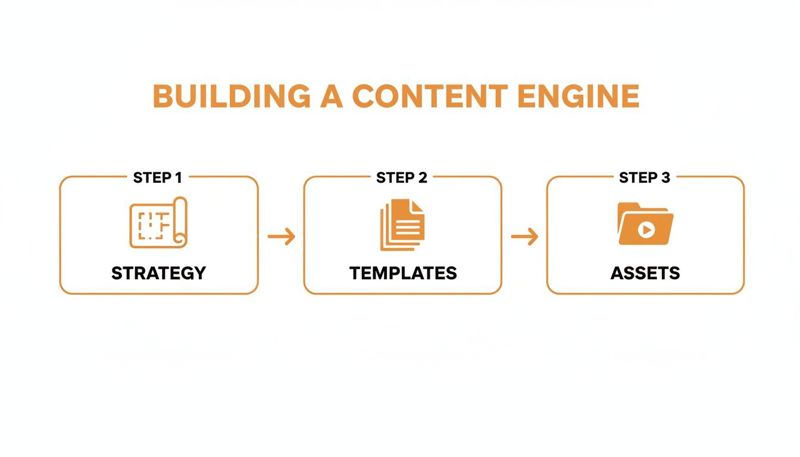
As you can see, a clear strategy and a solid set of templates are the building blocks you need before you can effectively scale up your asset production.
Building Your Tech Stack for Scaled Content
Your content automation stack doesn’t need to be complicated. It just needs to work together. The market for these tools is exploding right alongside the content marketing industry itself, which is projected to grow from $413.3 billion in 2022 to a staggering $1.95 trillion by 2032. With AI tools becoming more common, scaling content creation really comes down to smart technology.
Here’s what a simple, effective stack usually looks like:
- A Central Data Source: This could be your CRM (like HubSpot), an ESP (like Klaviyo), or even something as straightforward as a Google Sheet or Airtable base. This is where all your personalization data lives.
- A Content Templating & Generation Tool: This is the heart of your visual automation. A platform like OKZest lets you design your master templates and then connect them to your data source through an API or a direct integration.
- A Distribution Platform: These are the channels where your content actually gets seen—your email platform, social media scheduler, or website CMS.
When you're looking at tools, you might also consider specialized AI solutions like an AI-powered blog generating tool to help speed up your written content as well.
Pro Tip: Always have a backup plan for missing data. A must-have feature in any personalization tool is the ability to set "fallback" rules. If a customer's first name is missing, the system should automatically default to something friendly like "Hello there!" This makes sure your campaigns always look professional and never show broken personalization like
Hello, {{FirstName}}!.
By carefully picking tools that play well together and solve your biggest headaches, you build a tech stack that works for you—not the other way around. This thoughtful approach is the key to scaling your content creation in a way that actually lasts.
Putting Your Personalized Content Into Play Across Channels

Alright, you've laid the groundwork. The strategy is set, the templates are built, and your tools are ready to go. Now for the fun part: seeing your scalable content engine actually start generating results. This is where theory becomes practice, and every customer interaction starts to feel genuinely personal.
Flipping the switch isn't the whole story, though. Launching this requires a specific plan for each channel to make sure the personalized content feels natural and genuinely adds value. Let's dig into exactly how to make this happen across your marketing ecosystem.
Give Your Email Marketing a Serious Boost
Email is still one of the best channels for personalization, but you have to go beyond the basic {{FirstName}} merge tag to see a real lift. This is where personalized images come in—they're a total game-changer for grabbing attention in a crowded inbox.
Imagine you're running an e-commerce store. Instead of sending another generic "Welcome" email, you could use a tool like OKZest to create a unique image for every new subscriber. Hook it up to your ESP, like Klaviyo or Mailchimp, and you can pull in their name and the first product they looked at. The result? A header image that says, "Welcome, Jessica! That blue jacket looks great on you." That’s how you make someone feel like the message was crafted just for them.
Here's how that workflow breaks down in practice:
- Design a master template in your personalization tool. This could be a slick email header or a promotional banner.
- Mark the dynamic fields you want to personalize—the customer's name, a product image, or maybe a unique discount code.
- Connect your data by linking the template to your ESP's customer list. The tool then generates a unique image URL for every single subscriber.
- Embed the image in your email editor using the special merge tag your tool provides.
When you hit send, your ESP automatically slots the right personalized image in for each person. It’s a seamless process on the back end that delivers a powerful one-to-one experience on the front end.
Scale Up Your Social Media Game
Social media is all about making connections, but creating personalized content for thousands of followers can feel completely overwhelming. The secret is automation, especially for high-touch moments like influencer outreach or even just replying to DMs.
Take creator marketing, for example. It's a huge opportunity. The industry is on fire, with 93% of brands planning to ramp up their efforts and 94% saying creator content delivers a better ROI than traditional ads. To stand out, you have to personalize your outreach. Instead of a copy-paste DM, you can automatically generate a unique graphic for each influencer that says, "Hey @[InfluencerHandle], we love your style! Let's collaborate." You can dive into more stats about the rise of the creator economy on tribegroup.co.
A personalized visual in a DM cuts through the noise far more effectively than a block of text. It shows you've put in the effort and makes your proposal feel exclusive and professional.
You can apply this same idea to customer engagement. If a customer tags you in a post, use automation to reply with a personalized thank-you image that includes their username. It's a small touch that can turn a happy customer into a loud and proud brand advocate.
Create Dynamic Website and Chatbot Experiences
Your website and chatbots are prime real estate for creating a consistent, personalized journey from start to finish. When a customer logs back into their account, the experience should change for them. They shouldn't see a generic homepage banner; they should be greeted with a personalized image highlighting products related to what they've bought before.
You can pull this off by embedding a small snippet of HTML on your site. The code simply calls your personalization tool, which generates an image on the fly based on the user's data—their name, loyalty status, or browsing history.
Here’s where you can put this to work:
- Website Banners: Welcome logged-in users by name or show them an exclusive offer.
- Chatbot Interactions: When a user starts a chat, the bot can show a visual menu with their name or order details already filled in.
- Event Certificates: If you run webinars or online courses, you can instantly generate and display a personalized certificate of completion right on your site.
By executing your strategy across these key channels, you transform content creation from a manual, time-consuming task into an automated system for building real relationships. Every personalized touchpoint reminds your customers that you see them as individuals, which is exactly how you build loyalty and drive meaningful engagement.
Keeping Quality High and Fine-Tuning Your Strategy
Scaling your content is an exciting step, but pushing for speed without any guardrails is the fastest way to weaken your brand. As you start pumping out more and more content, the risk of sloppy, inconsistent work goes up right along with it. This is the point where you have to shift from just making stuff to a smarter cycle of creating, checking your work, and constantly improving.
Protecting your brand’s reputation is everything. It only takes one poorly-made, error-filled graphic or email to damage the trust you’ve spent years building. That’s why a solid quality control (QC) process isn’t just a nice-to-have—it’s a non-negotiable part of scaling content the right way.
Building a Practical Quality Control Process
Don't worry, your quality control process doesn't need to be some bureaucratic nightmare. The whole point is to create a lightweight system that’s still effective enough to catch mistakes and keep everything consistent without bringing your whole operation to a screeching halt. It should be straightforward, written down, and easy for the whole team to get on board with.
Everything starts with your brand guidelines. These need to be crystal clear and available to anyone who touches the content. Think of this document as your single source of truth for everything from correct logo usage and color palettes to the specific tone of voice you use for different customers. When your guidelines are clear, there's no room for guesswork.
Next, put together a simple review checklist. This isn’t a 50-point inspection designed to bog you down. Instead, it should just cover the absolute must-haves:
- Brand Fit: Do the visuals and the words feel like us?
- Data Check: Are all the personalized bits (like names or company info) showing up correctly?
- Clarity & Polish: Is the text easy to read, and are there any obvious typos or grammar mistakes?
- Link Check: Do all the buttons and links actually go where they're supposed to?
Plenty of tools, including the higher-tier plans at OKZest, let you set up specific roles for projects and reviews. This is huge because it means you can build quality control right into your workflow. For example, a designer could be in charge of setting up the initial template, but a marketer gets the final look to double-check the data connections and copy before anything goes out the door.
Creating a Data-Driven Feedback Loop
Creating personalized content at scale without measuring what happens next is like shouting into the wind. Sure, you’re making a lot of noise, but you have no idea if anyone is actually paying attention. To really dial in your strategy, you need to close the loop with data, turning performance numbers into smart changes for your next batch of content.
This means you have to look past vanity metrics like impressions. When you’re personalizing at this level, you need to track the numbers that tell you if the personalization is actually doing its job. The trick is to compare how your dynamic, personalized assets perform against your old generic, one-size-fits-all versions.
The most crucial part of scaling content is creating a feedback loop. You produce, you measure, you learn, and then you refine. This iterative cycle is what separates sustainable growth from simply creating more noise.
Key Metrics for Scaled Content Performance
You'll need to look at different data depending on the channel. A high-five on social media means something very different from a click in an email. Here’s a breakdown of the essential metrics to track to measure the true impact of your personalization efforts.
| Channel | Primary Metric | Secondary Metric | What It Tells You |
|---|---|---|---|
| Click-Through Rate (CTR) | Conversion Rate | Shows if personalized images are compelling enough to drive action. | |
| Social Media | Engagement Rate (Likes, Comments, Shares) | Reply/DM Rate | Measures how well personalized visuals resonate and spark conversation. |
| Website | Time on Page | Bounce Rate | Indicates if dynamic content is holding visitor attention and encouraging exploration. |
| Chatbots | Task Completion Rate | User Satisfaction Score | Reveals if personalized visuals are helping users achieve their goals more easily. |
By keeping a close eye on these specific metrics, you get a much clearer picture of what’s actually connecting with your audience. For instance, you might discover that emails with personalized images—showing a customer’s name and a product they just looked at—get a 35% higher CTR than your standard promo banners. That’s a game-changing insight.
This data is the fuel for your optimization engine. Use it to A/B test different template designs, tweak your copy, and go all-in on the personalization tactics that are actually delivering results. Scaling isn’t a one-and-done setup; it's a continuous process of creating, measuring, and improving that gets smarter with every single campaign you launch.
Your Top Questions About Scaling Content Creation, Answered
Jumping into scaled content creation can feel like a massive undertaking. It's totally normal to have questions about the budget, your team's capacity, and whether automation is going to suck the soul out of your brand. Let's dig into some of the most common worries that pop up when it's time to build a real content engine.
How Can I Scale Content With a Small Team and an Even Smaller Budget?
Look, scaling doesn't mean you need to sign a massive check or hire a whole new department overnight. The secret is to start small and prove it works.
Don't try to automate your entire marketing stack at once. That’s a recipe for disaster. Instead, find the single most annoying, repetitive content task on your team's plate.
Is it creating 50 slightly different versions of a social media graphic for a new launch? Or maybe it's manually adding names to header images for your weekly email? Pick one of those headaches and make it your first target.
Use tools that have free or low-cost starting points to build your proof of concept. For example, you could hook up a simple Google Sheet with a list of names to a single visual template in a tool like OKZest. When you can show a clear win—even if it just saves the team a few hours a week—you build an undeniable case for doing more. This approach shows the value of scaling without needing a huge budget or team shake-up.
Will Automation Make My Content Feel Cold and Impersonal?
This is a big one, and it comes from a misunderstanding of what smart automation actually does. Done right, it unlocks a level of personalization you could never, ever pull off manually. You aren't automating creativity; you're automating the boring, mechanical parts of production.
Your team is still the creative engine. They’re the ones designing the stunning templates, writing copy that connects, and setting the overall strategy. The automation is just a super-fast assistant that takes their creative framework and populates it with unique data for every single person.
The "robotic" feel everyone worries about comes from generic, one-size-fits-all content. Ironically, that’s the exact problem that intelligent scaling is built to solve. True personalization makes content feel more human and relevant, not less.
What Roles Do I Need on a Scalable Content Team?
As you start to grow, giving people specific roles is crucial for efficiency. In the early days, one person might be juggling a few of these, but it’s helpful to think of them as distinct functions. It brings a lot of clarity to the process and makes sure nothing important falls through the cracks.
A solid, scalable content team usually boils down to these core functions:
- Content Strategist: This person is the architect. They figure out the "why," mapping out the master templates, audience segments, and messaging that guide everything else.
- Designer/Creator: The creative spark. They build the visual and copy assets that live inside the templates, making sure everything is on-brand and looks fantastic.
- Technical Marketer: The one who connects the dots. This person links the data sources (like your ESP or CRM) to the creative templates and manages the automation tools to keep the whole system running.
- Project Manager: The conductor of the orchestra. They oversee the entire workflow from start to finish, manage timelines, and do the final quality checks before anything goes live.
Even if your team is just two people, defining these functions creates clear ownership and makes the whole process—from idea to execution—run a lot smoother.
Ready to stop creating visuals one by one and finally scale your personalization? With OKZest, you can automate thousands of unique images for email, social media, and your website. Think of it as merge tags, but for your images. Try OKZest for free and build your first personalized image template in minutes.