When most people hear marketing automation for agencies, they think it’s just a way to save a bit of time on repetitive tasks. A handy tool, sure, but not a game-changer.
The reality is so much bigger. It’s the engine that can truly scale your agency, transforming you from a chaotic, reactive service provider into a streamlined, strategic partner for your clients.
Why Marketing Automation Is Your Agency's Growth Engine

Let's be real about the day-to-day agency grind. Your team is probably stretched thin, juggling a dozen client demands while also trying to keep your own business growing. The day gets eaten up by manual work that doesn't move the needle—pulling reports for ten different clients, painstakingly personalizing email campaigns, or onboarding new accounts with a clunky, inconsistent process.
This operational drag isn't just burning out your best people. It's putting a hard cap on your revenue.
This is exactly where automation flips the script. It’s not about just scheduling a few social media posts. It’s about building intelligent systems to handle all those predictable, repeatable tasks so your team can focus on what clients actually pay you for: sharp strategy and creative solutions.
From Manual Labor to Strategic Value
Think about an agency stuck at a revenue plateau. Their team is sinking over 20 hours a week just manually compiling performance reports and ticking off an onboarding checklist. All that admin time leaves almost no room for proactive strategy, which leads to reactive client management and zero growth.
Now, imagine that same agency implements a marketing automation platform and builds two key workflows:
- Automated Client Onboarding: A smart sequence that sends welcome materials, gathers assets through forms, and schedules kickoff calls—all without a single manual touch.
- Automated Performance Reporting: A system that pulls data from various ad platforms and analytics tools into a clean, client-friendly dashboard, delivered like clockwork on the first of every month.
The result? They got those 20 hours back. Every single week. That time was immediately poured into strategic planning, brainstorming new campaign ideas, and delivering deeper performance insights. Within six months, they saw a 30% jump in client retainers simply because they were no longer just task-doers; they were indispensable partners.
This is the real power of marketing automation for agencies. It’s a direct path to boosting efficiency, proving your value, and scaling your operations without having to scale your headcount at the same rate. For more on this, check out our guide on how to automate and scale your marketing.
The True Benefits for Your Agency
Once you get past the simple "save time" perk, you realize automation is essential for survival and growth. It helps you deliver consistent, high-quality work for every client, every single time. By systemizing your processes, you build a solid foundation that can support a much larger client base without letting service quality slip.
For a deeper dive into these strategies, this detailed guide on Marketing Automation for Agencies is a fantastic resource. It’s about building a smarter, more scalable business.
How to Build a Winning Automation Strategy
Let's talk about a classic agency mistake. We get excited about a powerful new automation tool, sign up, and then... it just sits there. It's the fastest way to end up with expensive "shelfware" and clients wondering what they're paying for.
A truly successful automation program doesn't start with a demo. It starts with a clear, intentional strategy, both for your own agency and for every client you serve.
This isn't about features; it's about outcomes. Before you even think about technology, you need to map out what actually matters. Where are the biggest friction points in the customer journey? Where are good leads falling through the cracks? What repetitive, manual tasks are sucking up your team's most valuable hours? Answering those questions first is how you make sure your automation efforts are targeted and deliver real impact.
Start with the Highest-Impact Areas
Don't try to automate everything at once. That's a recipe for getting overwhelmed. Instead, focus on the areas that will deliver the most visible and immediate value. For most agencies, these "quick wins" fall into a few key categories that directly boost efficiency and client results.
Here are the most common places we see agencies start:
- Client Onboarding: Build a standardized, automated sequence to welcome new clients. You can collect necessary assets, schedule kickoff calls, and set expectations from day one. It creates a seamless, professional experience every single time.
- Lead Nurturing: Design workflows that automatically follow up with new leads. Send them valuable content that’s tailored to their interests and gently guide them toward a sales conversation without any manual intervention.
- Performance Reporting: This is a huge one. Automate the soul-crushing process of pulling data from a dozen different sources. A system that compiles and sends a clean, branded report on the first of every month saves countless hours and consistently demonstrates your value.
By tackling these foundational areas first, you build momentum. You prove the concept's worth to your internal team and, more importantly, to your clients.
Set Clear and Measurable Goals
A strategy without goals is just a wish list. Every single automation workflow you build needs a specific, measurable objective that’s tied to a real business outcome. Vague goals like "improve engagement" are impossible to track and even harder to report on.
Get specific. Your goals should sound more like this:
- Increase the lead-to-customer conversion rate by 15% in 90 days.
- Reduce time spent on manual client reporting by 10 hours per month.
- Improve new client onboarding satisfaction scores from 7/10 to 9/10 within six months.
Pro Tip: Always, always establish a baseline before you launch a new automation. If you don't know your current conversion rate or how many hours a task takes right now, you'll have no way to prove the incredible ROI you’re delivering down the line.
The financial upside here is massive. Marketing automation delivers an incredible ROI, with every $1 invested returning an average of $5.44 over three years. This makes it a no-brainer investment for agencies looking to scale. With most agencies recouping costs in under six months while driving serious revenue growth for clients, the business case is impossible to ignore. For more on this, check out the powerful ROI of marketing automation.
A Real-World Strategy in Action
Let’s make this practical. We saw a B2B agency working with a software client whose sales funnel was leaking like a sieve. Leads would download a whitepaper, and then... crickets. They’d go cold, never booking a demo.
Instead of just throwing a new tool at the problem, the agency mapped the entire journey, from the first ad click to the final sales call. They quickly spotted a massive drop-off right after the whitepaper download. The reason? There was no consistent follow-up process in place.
Armed with that insight, they designed a simple but powerful lead nurturing workflow:
- Immediate Follow-Up: An email delivered the whitepaper instantly. No waiting.
- Value-Add Sequence: Over the next two weeks, a sequence of three automated emails went out. Each one shared a relevant case study or a short video clip related to the whitepaper's topic, keeping the conversation going.
- The Ask: The final email in the sequence made a direct offer for a personalized demo, specifically mentioning the pain points discussed in the content they'd already sent.
The results were immediate and undeniable. They plugged the hole in the funnel, proved their strategic value went way beyond just running ads, and locked in a long-term retainer. That’s the power of putting strategy first.
As you build out your own approach, drawing from essential marketing automation best practices can give you a proven framework for driving results and optimizing your operations.
Assembling Your Agency's Ideal Tech Stack
Think of your agency's tech stack as its central nervous system. Getting it right is the difference between a clunky, inefficient operation and a smooth, scalable powerhouse that delivers killer client results. With thousands of platforms all promising the moon, it’s easy to get lost.
But this isn’t about chasing the newest, shiniest object. It's about building a cohesive ecosystem that actually works for you, not the other way around. The goal is to pick tools that talk to each other, grow with your agency, and ultimately make your team smarter and faster.
The Three Pillars of Your Automation Stack
Every solid marketing automation stack, no matter the size, is built on three essential pillars. These are the absolute non-negotiables that form the foundation of your service delivery. Nailing this core is the first and most critical step.
- Customer Relationship Management (CRM): This is your single source of truth. A good agency CRM is more than a contact list; it tracks every interaction, deal stage, and conversation, giving you a 360-degree view of every relationship you manage.
- Email Service Provider (ESP) / Automation Engine: This is the workhorse. Whether it's a dedicated ESP like Mailchimp or Klaviyo, or a more robust engine like ActiveCampaign, this tool is what actually executes your automated workflows—from lead nurturing to client onboarding.
- Integration and Workflow Hub: This is the glue holding everything together. Tools like Zapier or Make are lifesavers, letting you connect apps that don't have native integrations. They create seamless data flows between your CRM, ESP, project management tools, and everything else.
All-in-One vs. Best-of-Breed: Picking Your Path
Now, how do you actually assemble these pillars? Agencies typically go one of two ways: an all-in-one suite that tries to do everything, or a "best-of-breed" stack where you hand-pick the best tool for each specific job.
Choosing Your Agency's Automation Stack
Deciding between an all-in-one suite and a specialized best-of-breed stack depends on your agency's clients, budget, and technical comfort level.
| Consideration | All-in-One Platform (e.g., HubSpot) | Best-of-Breed Stack (e.g., ActiveCampaign + Zapier + Specialized Tools) |
|---|---|---|
| Simplicity | One login, one bill, one support team. Generally easier to learn and manage. | Multiple platforms to learn and integrate. Requires more technical oversight. |
| Functionality | A "jack-of-all-trades, master of none." Good at many things, but rarely the best at any single one. | Pick the absolute best tool for each specific function (e.g., email, CRM, analytics). |
| Flexibility | You're locked into their ecosystem. Switching can be a massive undertaking. | Highly flexible. You can swap out individual tools as better options emerge. |
| Cost | Often a higher upfront cost, but can be more predictable. Per-seat pricing can add up fast. | Can start cheaper, but costs can grow as you add more tools and contacts. |
| Best For | Agencies that value simplicity and serve clients who need a broad, integrated solution. | Agencies that want maximum power and customization for specialized client needs. |
There's no single right answer here. An all-in-one platform like HubSpot might be perfect if your team values simplicity and a unified interface. But if you want the absolute best-in-class tool for every task, a curated stack gives you that power and flexibility.
What to Look For in Agency-Ready Tools
When you're evaluating software, remember that agency needs are different. You’re not just managing one business; you’re managing many. Your tools have to reflect that reality.
Here’s what I always look for:
- Client-Level Permissions: This is non-negotiable. Can you give a client a login to see only their own data and dashboards? If not, it's a deal-breaker for transparency and security.
- Robust Integration Capabilities: Siloed data is the enemy. Check for a strong API and a healthy library of pre-built integrations. You need your tools to talk to each other without constant manual work.
- Scalability: Will the platform's pricing and features grow with you? Avoid tools that will hit a wall and force a painful migration down the road.
Building the right tech stack is a strategic decision that directly impacts your profitability and client retention. You're investing in a system that lets your team graduate from manual tasks to high-level strategic work.
The investment in this space is exploding for a reason. In the fast-paced agency world, automation has become mission-critical. The global marketing automation market is projected to surge from $6.65 billion to an astounding $15.58 billion by 2030. That's not just a trend; it's a fundamental shift in how modern agencies operate. You can dig into more of these market trends to see why everyone's jumping in.
Gaining a Competitive Edge with Specialization
Once your core stack is solid, the real fun begins. You can start adding specialized tools that give you a unique competitive advantage and seriously elevate the client experience. This is where you differentiate your agency.
One of the most powerful ways to do this is with hyper-personalization.
Let's be honest, a generic email with a {{first_name}} tag is table stakes now. The next frontier is personalizing the visuals in your communications, at scale.
This is where a tool like OKZest comes into play. It lets you dynamically generate unique, personalized images for every single contact on an email list. Imagine sending a webinar follow-up where each attendee gets a certificate with their name beautifully rendered on it. Or a real estate update where each prospect sees an image of a home with a "Welcome Home, Sarah!" sign on the door.
This isn't some complicated coding project. You achieve this with simple merge tags inside the platforms you already use, like Klaviyo or Mailchimp. By adding a tool like this, you’re not just sending an email; you’re creating a memorable experience that makes your agency’s work impossible to ignore. We break down exactly how to integrate an image personalization API to get these kinds of results.
This approach transforms a standard automation workflow into something that feels personal and bespoke, dramatically boosting engagement and proving the value you bring to clients. It’s a perfect example of how adding just one specialized tool can elevate your entire service offering.
High-Impact Automation Plays for Your Clients
Great, you've got your strategy and tech stack sorted. But that's just the foundation. The real magic happens when you start building smart, automated workflows that solve genuine client problems and deliver results they can't ignore. This is where your agency goes from running simple welcome sequences to delivering high-value "plays" that make you indispensable.
These aren't just about scheduling emails. We're talking about creating timely, personalized experiences that seamlessly guide a customer from one stage to the next. The goal is to build automated systems that feel incredibly personal, delivering the perfect message at the exact moment it matters most.
And the demand for this is exploding. A staggering 91% of organizations are feeling the growing need for marketing automation across all their departments—from marketing and R&D to operations and service. That puts agencies like yours in a prime position, especially since 70% of leaders are planning to pump more money into their automation budgets. You can dig into these powerful market statistics yourself and see how the market is forecast to hit $15.5 billion by 2030.
Playbook 1: The Consulting Client Webinar Funnel
For any consulting client, webinars are a goldmine for generating highly qualified leads. But let's be honest, the manual grunt work of promotion, reminders, and follow-up can be a total nightmare. A well-oiled automated funnel doesn't just save dozens of hours; it seriously boosts attendance and conversion rates.
This is the basic flow for putting the right tools together—from capturing leads in a CRM to running campaigns through an ESP and your automation engine.
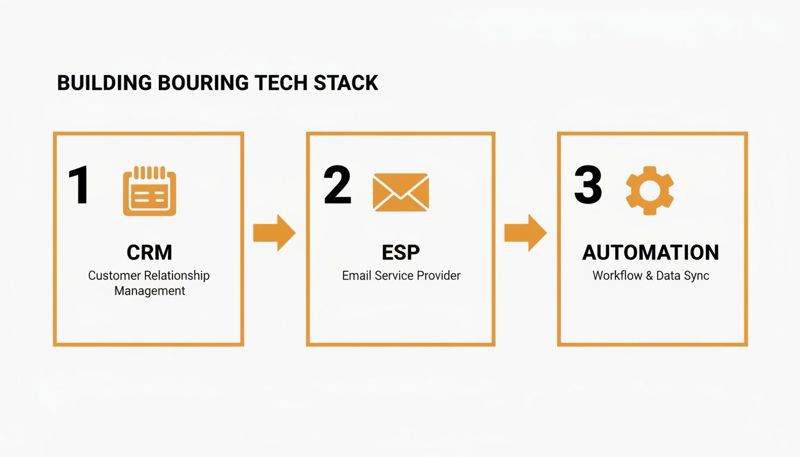
This setup makes sure every step of your client's funnel is backed by the right tech, creating a smooth, uninterrupted flow of data.
Let's break down the actual workflow:
- Promotion & Registration: Kick things off with a multi-channel promo sequence (email, social) driving people to a landing page. As soon as someone signs up, they get tagged in the CRM (e.g.,
[Webinar] Registered - April 2024) and instantly receive a confirmation email. - Pre-Webinar Nurturing: Next, a reminder sequence kicks in. This isn't just a boring "don't forget!" email. We're talking value-adds like a speaker bio, a sneak peek of a key slide, or a prompt for them to submit questions ahead of time.
- Day-Of Reminders: To maximize live attendance, automated emails go out 24 hours before, one hour before, and 10 minutes before showtime. Simple, but incredibly effective.
- Post-Webinar Segmentation: This is where the real money is made. The system automatically splits attendees into two buckets: those who actually showed up, and those who registered but were a no-show.
- Targeted Follow-Up: Each group gets a completely different email sequence. Attendees get the recording and a clear call-to-action to book a consultation. No-shows get a "sorry we missed you" email with the recording, followed by a gentle nurture sequence to re-engage them.
Hyper-Personalization in Action: For the people who attended, why not blow them away? The follow-up email can include a dynamically generated certificate of completion from OKZest. Imagine them getting an email with a slick, personalized certificate with their name on it. That’s how you turn a standard follow-up into a memorable brand experience.
Playbook 2: The Real Estate Client Listing Alert System
In real estate, speed and relevance are everything. A potential buyer needs to know about a property that fits their criteria the second it hits the market. A dynamic alert system is the perfect job for automation, turning your client’s website into a lead-nurturing machine that works 24/7.
This playbook connects their property database directly to their email platform, creating a powerful, automated line of communication.
Designing the Dynamic Workflow
It all starts when a prospect uses the search filter on your client’s website or fills out a "what I'm looking for" form. Their specific criteria—location, price range, number of bedrooms—get saved to their contact profile in the CRM. That data is the trigger for the entire automation.
- The Trigger: The automation is set to run daily or, for the real pros, in real-time via an API call whenever a new property matching a prospect's saved criteria is added to the MLS feed.
- The Action: The system automatically builds and sends an email to that specific prospect. This isn't a generic newsletter; it's a hyper-specific alert.
- The Content: The email dynamically pulls in the key info for the matching property: the main photo, the address, the price, and a link straight to the full listing.
This makes sure every single email is 100% relevant to what the prospect explicitly said they wanted. It's the polar opposite of spam—it’s a valuable service that builds trust and keeps your client's agency top-of-mind.
Adding a Layer of Unforgettable Personalization
You can take this playbook from effective to absolutely brilliant. By integrating a tool like OKZest, the alert email can feature a dynamically generated image of the new property with a personalized message overlaid on it, like "Sarah, is this your new home in Austin?"
This is the kind of detail that creates a real emotional connection and shows a level of technical savvy that most other agencies just can't match. It’s these thoughtful, high-impact plays that turn automation from a simple efficiency tool into a core, undeniable part of your agency's value.
How to Measure and Report Automation ROI
<img src="https://okzest.blob.core.windows.net/blog/business-professional-analyzing-a-performance-graph-showing-growth-and-ro-on-a-monitor.jpg" alt="Business professional analyzing a performance graph showing growth and "RO%" on a monitor." width="800">
Let's be honest. Implementing a slick automation sequence is only half the job. The real test—the thing that keeps clients paying you month after month—is proving that your work is actually making them money.
Without hard numbers, even the most sophisticated automation strategy is just another line item on an invoice. Your goal is to shift the conversation from cost to investment. This is how you prove your worth and lock in those long-term retainers.
It’s time to graduate from vanity metrics. Open rates and social media likes might feel good, but they don't pay your client's bills. Your reporting needs to draw a straight line from your automated workflows to their revenue.
Focusing on Revenue-Driving Metrics
To really show off the power of marketing automation for agencies, your reports have to speak the language of the C-suite. We're talking about the numbers that directly impact the bottom line.
Your client dashboards should put these metrics front and center:
- Lead-to-Customer Conversion Rate: This is the ultimate proof that your nurturing works. What percentage of the leads you touched turned into paying customers?
- Customer Lifetime Value (CLV): Are your automated onboarding, upsell, and retention campaigns making each customer more valuable over time? Track it and show it.
- Sales Cycle Length: Time is money. If your workflows shorten the journey from prospect to buyer by 20%, that's a huge win for their sales team's efficiency.
- Marketing-Attributed Revenue: Use attribution models to connect the dots. Show exactly how much revenue was generated from that webinar follow-up sequence or that re-engagement campaign you built.
When you focus on these core business metrics, you stop being just a service provider. You become a strategic growth partner. You're not just checking boxes; you're building their business.
Building a Client-Facing ROI Dashboard
A spreadsheet full of numbers isn’t going to cut it. You need to tell a visual story of success. Create a clean, simple dashboard template you can use for every client, designed for clarity and impact.
But don't just dump the data in there. Interpret it. Use charts to visualize trends, and add short notes to explain why the numbers are moving. For example, next to a chart showing a spike in conversions, you could add: "Spike corresponds with the launch of the new 'Case Study' nurture path on March 15th."
This simple act connects your specific actions to their positive results. A great dashboard works for you even when you're not in the room, constantly reinforcing the value you bring.
Proving Your Impact with A/B Testing
Want undeniable proof of your ROI? Run an A/B test. It’s the cleanest way to isolate the impact of a specific strategy and remove all the guesswork. For instance, pit a generic email call-to-action against one using hyper-personalization.
Here’s a real-world example:
- The Control (Group A): Gets a standard follow-up email after a product demo. The CTA button is a generic "Learn More."
- The Test (Group B): Gets the same email, but the CTA is a dynamically personalized image from OKZest. It shows a product screenshot with the text "See Your Results, [Prospect Name]!"
Track the click-through and conversion rates for both. When Group B gets a 45% higher click-through rate, you have a concrete data point proving the value of your advanced tactic.
This is exactly how you justify your fees and show a level of expertise that most agencies can't touch. For a deeper dive into the numbers you should be tracking, check out our guide on essential email campaign analytics.
Common Questions About Agency Marketing Automation
Even with the best strategy and a slick tech stack, questions always pop up when you're in the trenches. Getting these answers right from the start can be the difference between a smooth, profitable project and one that slowly drains your time and energy.
Let's tackle the most common questions we hear from agencies.
How Should Our Agency Price Marketing Automation Services?
This is the big one. The key is to stop thinking about hours and start focusing on value. Billing by the hour for automation work immediately puts a ceiling on your earning potential and frames your service as just another line item. A much better approach is a value-based, tiered model.
This structure usually breaks down into two parts:
- A One-Time Setup Fee: This covers all the initial heavy lifting—the strategy sessions, workflow mapping, copywriting, tech integration, and the actual build-out. Think of it as a project fee for getting the foundational system up and running.
- A Monthly Retainer: This is for the ongoing work—the management, monitoring, A/B testing, and continuous optimization. You can create tiers based on the number of active workflows, the size of the contact list, or the overall complexity of the setup.
When you present pricing, always tie it directly to a business outcome. Don't just say, "It's $1,500 a month."
Instead, frame it like this: "This $1,500 per month retainer will manage and optimize the system we project will increase your qualified leads by 20%." This simple shift changes the conversation from a cost into a strategic investment.
What Is the Biggest Mistake Agencies Make Getting Started?
The most common—and most costly—mistake is buying a powerful, expensive tool before having a crystal-clear strategy. Agencies get mesmerized by a platform’s endless feature list and all the shiny bells and whistles. They forget to first diagnose the client’s actual business problem. This almost always leads to paying for an overly complex system that the team never fully uses.
The right sequence is always strategy first, tool second. Before you even look at a demo, you must map the client's customer journey, pinpoint the exact bottlenecks where leads are dropping off, and define what measurable success will look like. Only then can you choose a tool that fits the strategy.
Going in this order prevents you from overinvesting in tech your client doesn’t need. More importantly, it ensures your efforts are laser-focused on solving the most critical problems from day one.
How Much Time Is Realistic for a New Client Setup?
Having a solid benchmark for setup time is essential for scoping projects and quoting accurately. While every project is different, you can use some general guidelines.
A foundational setup—think a welcome email series and a core lead nurturing sequence—typically requires 15-20 hours for strategy, building, and testing.
A more advanced implementation with multiple integrations, custom data fields, and dynamic content personalization might take 40-60 hours upfront.
For ongoing retainers, a good rule of thumb is to budget 5-10 hours per month per client for monitoring, reporting, and making continuous improvements.
Ready to elevate your client campaigns with unforgettable visuals? OKZest lets you automate personalized images for every email, turning standard workflows into memorable experiences that drive engagement. Learn how to add merge tags for images today.